Intro: What is Finance Flow?
In the context of export-import (EXIM) trade, fi nancial fl ow refers to the movement of money or foreign exchange between countries as a result of goods and services being exchanged. For exports, this means the receipt of foreign exchange by the exporter, while for imports, it involves payments made for purchases. This process is often facilitated by banks through various fi nancial instruments and fi nancing methods like pre-shipment and post-shipment credit. International trade, also known as EXIM (Export-Import) trade, inherently involves a range of fi nancial challenges that can signifi cantly impact the success and profi tability of businesses. These challenges include currency risks, payment risks (such as delayed payments), and fi nancing gaps. Successfully navigating these issues requires careful evaluation and strategic planning.

Main Financial Challenges in EXIM Trade
1. Currency Risks (Foreign Exchange Fluctuations Risks)
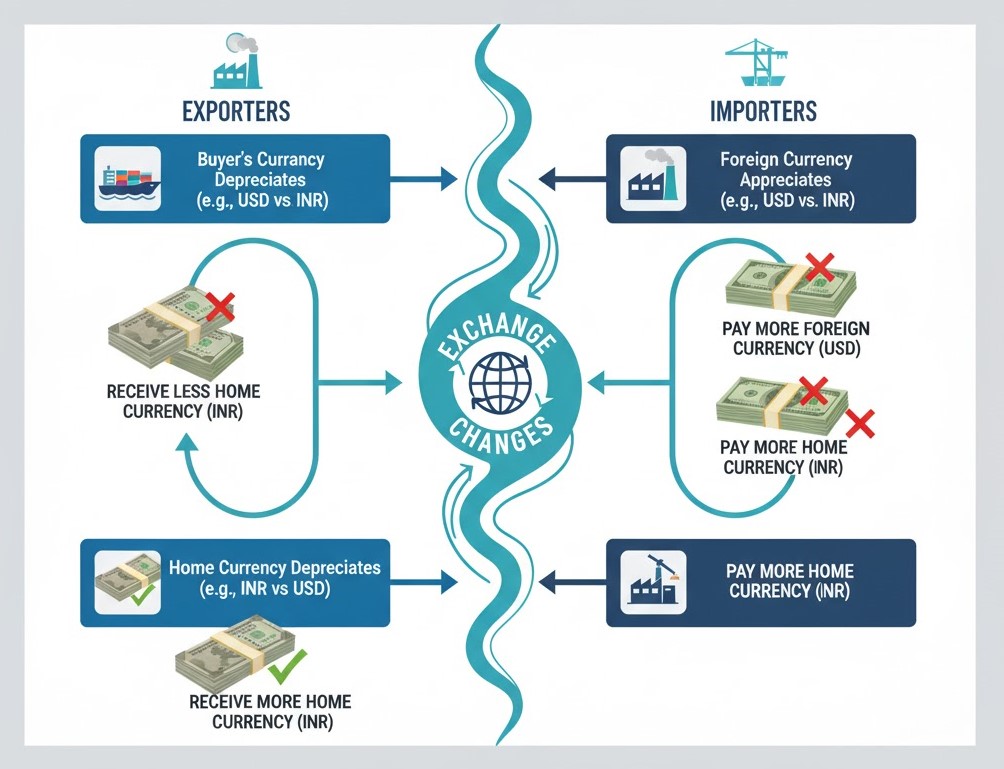
- These risks arise from changes in the exchange rates between currencies.
- If an exporter invoices in the buyer's currency, and that foreign currency depreciates against the exporter's home currency (e.g., Indian rupees), the exporter will receive a lesser amount in their home currency.
- Conversely, if the home currency depreciates, the exporter stands to gain.
- Importers face a similar risk if they need to purchase foreign currency to pay suppliers, and the foreign currency appreciates.
2. Payment Risks (Credit Risks and Delayed Payments)
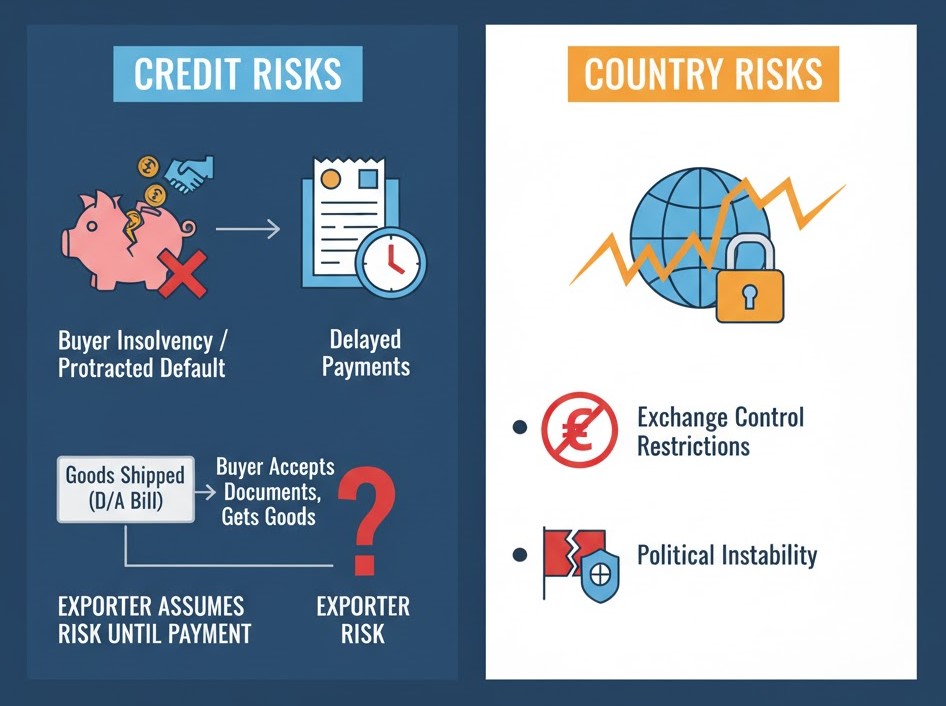
- These risks refer to the possibility of not receiving payment for goods sold on credit.
- This can occur due to the buyer's insolvency or protracted default in payment, or even if the buyer makes payment, but the funds cannot reach the exporter due to exchange control restrictions or political instability in the buyer's country.
- In the case of Documents against Acceptance (D/A) bills, the importer obtains possession and title to goods upon acceptance, meaning the exporter has extended credit and assumes the commercial risk of default until payment is received.
3. Financing Gaps (Working Capital and Credit Needs)
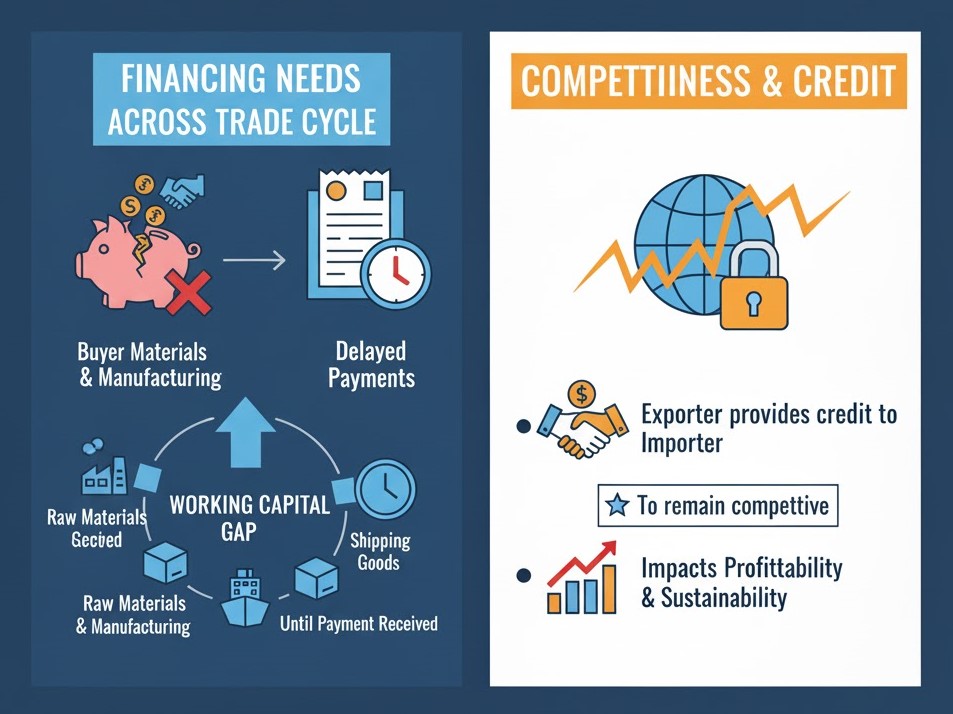
- These gaps refer to the need for financial assistance at various stages of the export transaction, from procuring raw materials to manufacturing, processing, packaging, and ultimately, until the export proceeds are realized. Exporters may also need to provide credit facilities to importers to remain competitive.
- In summary, financial challenges in EXIM trade are multifaceted and span the entire trade cycle. They matter because they directly impact a business's profitability, competitiveness, and sustainability in the global market. Understanding these risks and leveraging available tools and services for mitigation is essential for success.
Test Your Knowledge
Question 1: What are the three main financial challenges in EXIM trade?
Question 2: How does foreign exchange hedging help mitigate currency risk?
Question 3: What is the primary purpose of pre-shipment finance?
Process: Financing Methods & Suitability
1. Methods of Receiving Payment
The choice of payment method is crucial and depends on various factors, including the bargaining strength of the trading partners, exporter's knowledge of the buyer, buyer's financial ability, and exchange restrictions in the importer's country. Different methods carry varying degrees of risk to the exporter.
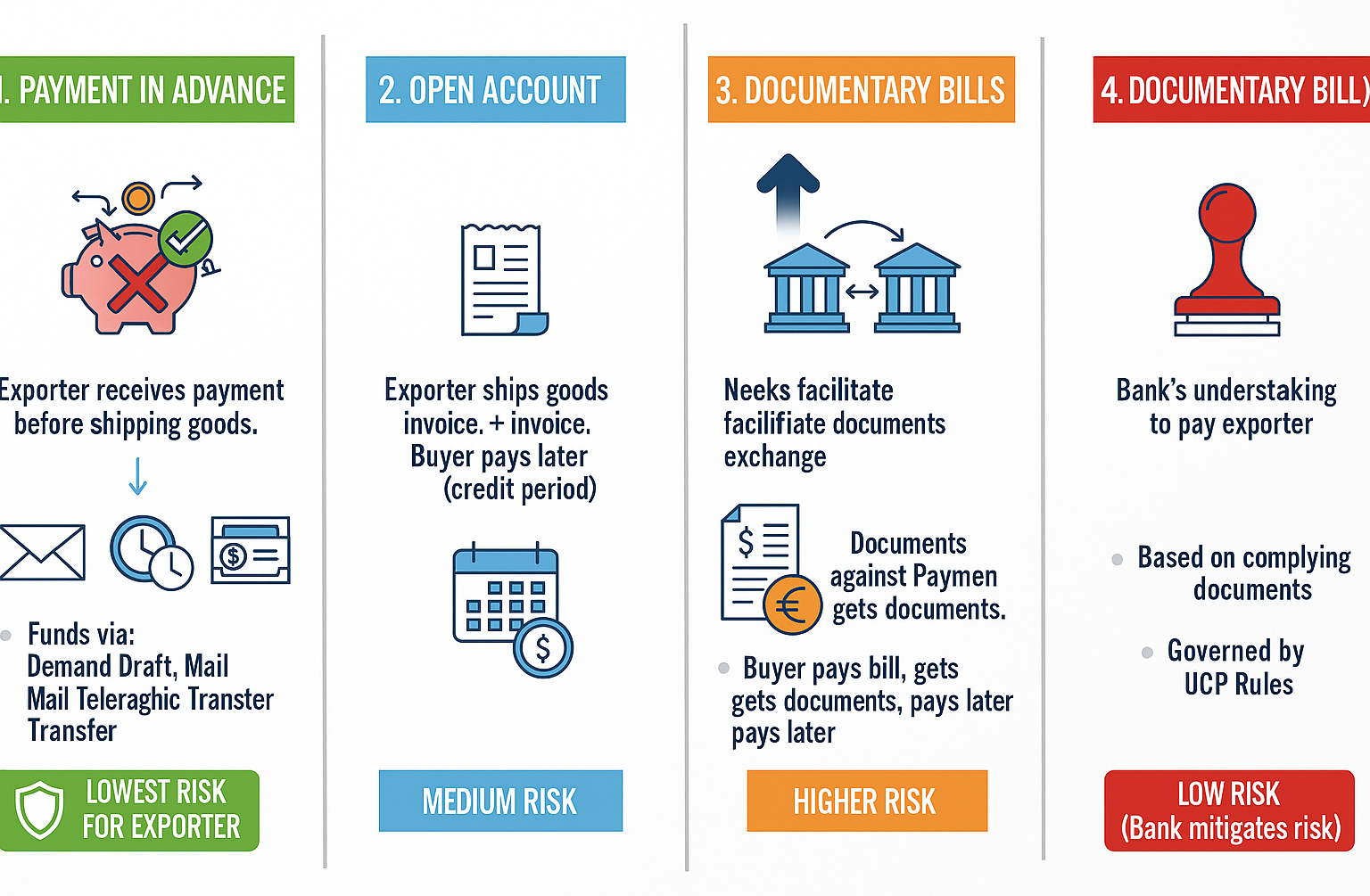
1. Payment in Advance (Cash in Advance)
This method involves the exporter receiving payment from the importer before the execution of the order. Payment can be at the time of receiving the order or in installments before final execution. It is typically received via demand draft, mail transfer, or telegraphic transfer in the currency specified in the contract.
2. Open Account with Periodic Settlement
The exporter sends goods directly to the overseas buyer along with the invoice, without drawing a bill of exchange. The buyer then typically makes payment upon the expiry of a stipulated credit period.
3. Documentary Bills (Documents against Payment - D/P and Documents against Acceptance - D/A)
When advance payment is not feasible, Documentary Bills provide a solution by routing documents through a bank, thereby reconciling the conflicting requirements of both exporter (security of payment) and importer (receipt of goods). Banks act as intermediaries. A Documentary Bill of Exchange is one where relative shipping documents (e.g., Bill of Lading, marine insurance policy, invoice) are sent along with the Bill of Exchange.
4. Documentary Credit under Letters of Credit (LC)
An undertaking by a bank to make payment to the exporter (beneficiary) under certain conditions and up to a certain amount, provided the stipulated documents are presented in strict conformity with the LC terms. The LC transaction is separate and independent from the underlying sales contract. It is governed by Uniform Customs & Practice for Documentary Credits (UCP), which banks use for negotiation of export-import documents.
2. Other Financial Support and Risk Management Tools
Here's a simple breakdown of some commonly used INCOTERMS:
Pre-shipment Finance (Packing Credit):
- Provided to exporters before goods are shipped to cover expenses like raw material purchase, processing, manufacturing, packing, and warehousing.
- It's granted against a confirmed export order or irrevocable LC, typically for 180 days at concessional rates.
Post-shipment Finance:
- Loans or advances granted by banks to exporters after the date of shipment until export proceeds are realized.
- This includes advances against export bills sent for collection, negotiation of LC documents, or advances against export incentives like duty drawback.
ECGC (Export Credit Guarantee Corporation of India):
- This government enterprise provides credit risk insurance to exporters to secure export payments against political and commercial risks.
- It covers risks such as buyer insolvency, protracted default in payment, and government restrictions on remittance.
Export Credit Insurance (General):
- Organizations like the Export-Import Bank (EXIM Bank), Overseas Private Investment Corporation (OPIC), and Foreign Credit Insurance Association (FCIA) provide insurance to exporters, enabling them to extend credit terms.
Foreign Exchange Hedging:
- This involves using the forward foreign exchange market to avoid foreign currency risk. An exporter or importer can contract today for future currency delivery at an agreed-upon price, thereby locking in an exchange rate and avoiding exposure to fluctuations.
Factoring:
- A financial service where a factor (agent) purchases accounts receivables from the seller at a discount, providing immediate cash flow.
- This allows businesses to unlock capital tied up in future income.
Buyer's Credit and Line of Credit:
- Buyer's Credit involves a financial institution extending credit directly to the buyer, allowing the exporter to receive immediate payment.
- A Line of Credit extends credit to a financial institution in the buyer's country, shifting the responsibility of assessing individual buyer creditworthiness and recovery to that institution.
Understanding these various financing methods and risk mitigation strategies is vital for exporters and importers to navigate the complexities of international trade effectively, ensure cash flow, manage exposure, and enhance their competitiveness in the global market.
Test Your Knowledge
Question 1: What is the main difference in risk for the exporter between D/P and D/A bills?
Question 2: What is the primary benefit of a Letter of Credit (LC) for an exporter?
Question 3: Name two "Special Types" of LC mentioned and briefly describe one.
Documents: LC, Bill of Exchange, Payment Receipt
1. FINANCE FLOW (Primary Focus: Payment & Financial Instruments)
| Document Name | Who Uses It | Importance Level | Mandatory / Optional | Trade Phase |
|---|---|---|---|---|
| Letter of Credit (L/C) | Importer (applies); Exporter (beneficiary) | Critical | Optional | Financing & Risk Mitigation |
| Request to Open L/C | Importer | High | Optional | Financing & Risk Mitigation |
| Irrevocable L/C | Both parties | Critical | Optional | Financing & Risk Mitigation |
| Confirmed L/C | Exporter (enhanced security) | High | Optional | Financing & Risk Mitigation |
| Standby L/C | Both parties | High | Optional | Financing & Risk Mitigation |
| Transferable L/C Original | beneficiary/middleman | Medium | Optional | Financing & Risk Mitigation |
| Assignment of Proceeds | Beneficiary | Medium | Optional | Financing & Risk Mitigation |
| Back-to-Back L/C | Intermediaries | Medium | Optional | Financing & Risk Mitigation |
| Bank Drafts / Bills of Exchange | Exporter | High | Optional | Financing & Risk Mitigation |
| Time (Date) Draft | Exporter | High | Optional | Financing & Risk Mitigation |
| Sight Draft | Exporter | High | Optional | Financing & Risk Mitigation |
| Surety Bond | Importer | Medium | Optional | Financing & Risk Mitigation |
| Commercial Invoice | Exporter (provides to importer) | Critical | Mandatory | Shipment & Transportation |
| Insurance Certificate | Exporter | High | Optional | Shipment & Transportation |
| Submission of Documents to AD Bank (India) | Exporter | Critical | Mandatory** | Post-shipment & Collection |
| Permanent Account Number (PAN) - India | Both parties | Critical | Mandatory** | General /Supporting |
| EBRC (Export Bill Realisation Certificate) | Exporter | Critical | Mandatory** | Post-shipment & Collection |
| Green Clause LC | Bank/Exporter | Medium | Optional | Financing & Risk Mitigation |
| Letter of Indemnity (LOI) | Shipper/Consignee | Medium | Optional | Shipment & Transportation |
| LUT (Letter of Undertaking) | Exporter | High | Optional** | Post-shipment & Collection |
| Periodic Monthly Statement (PMS) | Importer | High | Mandatory | Post-shipment & Collection |
| Red Clause LC | Bank/Exporter | Medium | Optional | Financing & Risk Mitigation |
| Sight Letter of Credit | Bank/Parties | High | Optional | Financing & Risk Mitigation |
| Standby Letter of Credit | Bank/Parties | High | Optional | Financing & Risk Mitigation |
| Transferable Letter of Credit | Bank/Beneficiary | Medium | Optional | Financing & Risk Mitigation |
| UTB (Uitnodiging Tot Betaling) | Dutch Tax Authority | High | Mandatory*** | Post-shipment & Collection |
Test Your Knowledge
Question 1: According to the table, which document is mandatory for both exporters and importers in India?
Question 2: What is the "Importance Level" for the "Declaration under Foreign Exchange (India)"?
Question 3: Is a "Sample Template Link" provided for any of the documents in this table?