Information & Data Flows in EXIM
Engaging in Export-Import (EXIM) trade involves a dynamic flow of information and data between various parties, both within a country and across international borders. Understanding this flow is crucial for smooth and efficient trade operations.

Information & Data Flows in EXIM
Engaging in Export-Import (EXIM) trade involves a dynamic flow of information and data between various parties, both within a country and across international borders. Understanding this flow is crucial for smooth and efficient trade operations.
1. How Information Moves in EXIM Trade
Information in EXIM trade moves through several channels, evolving from traditional paper-based methods to increasingly digital and integrated systems.
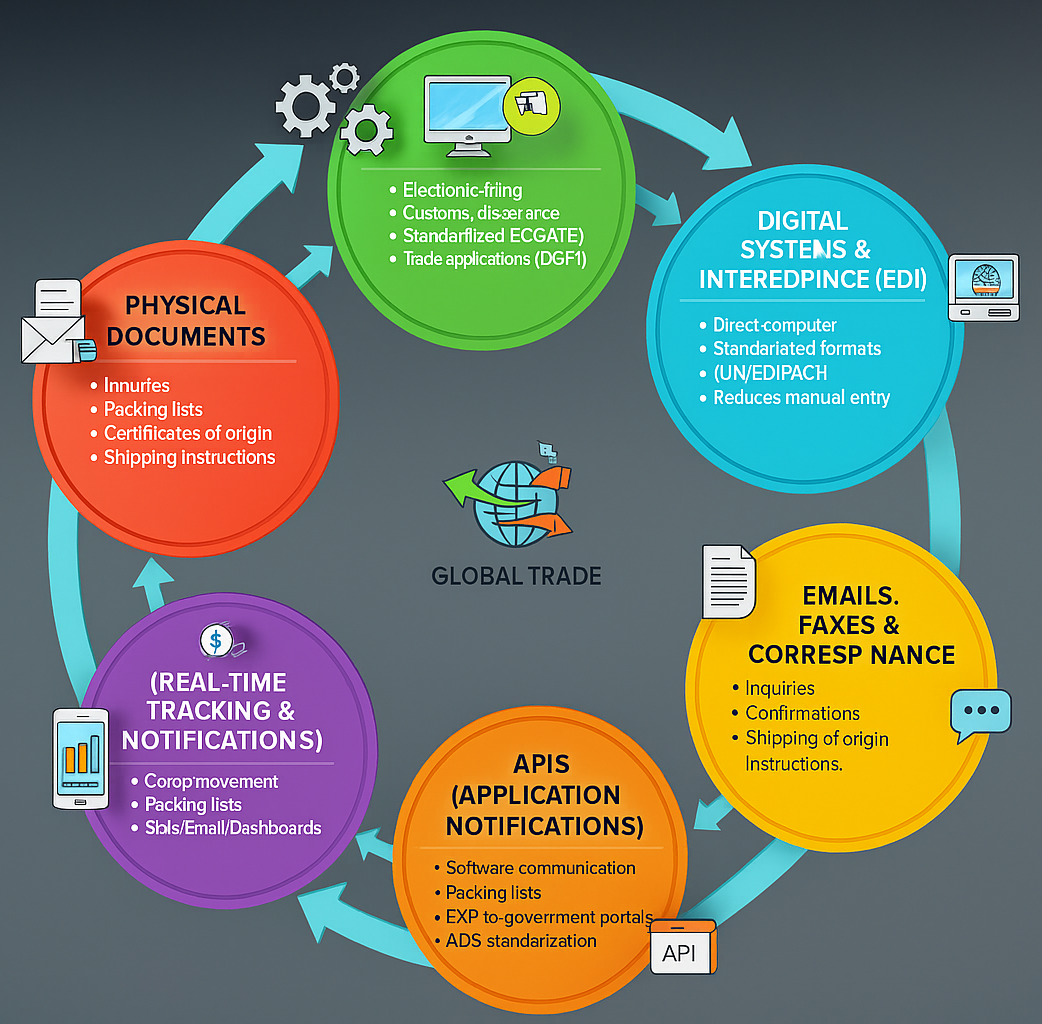
Digital Systems and Portals
- Many countries, including India, use electronic data interchange (EDI) systems and dedicated online portals for submitting and processing trade-related information.
- These systems allow for the electronic filing of applications, documents, and payments, reducing physical paperwork and transaction costs.
- For example, India uses ICEGATE for customs clearance and DGFT Trade Connect Portal for various trade applications.
Electronic Data Interchange (EDI)
- This refers to the direct exchange of trade documentation between computers, often following standardized formats like UN/EDIFACT. EDI aims to reduce manual data entry and speed up the exchange of information.
Emails, Faxes, and Other Correspondence
- While digital portals are becoming primary, emails and faxes are still widely used for initial inquiries, offers, order confirmations, shipping instructions, and general communication between exporters, importers, and agents.
Physical Documents
- Despite the push for digitalization, many core EXIM documents, such as commercial invoices, packing lists, bills of lading, and certificates of origin, still exist in physical form and are often required for various stages of the trade process.
- The Aligned Documentation System (ADS) aims to standardize the format and content of these pre-shipment export documents to streamline data entry.
Real-time Tracking and Notifications
- Information flow also includes updates on cargo movement, customs status, and payment realization, often provided through SMS, email, or integrated dashboards.
2. Main Portals and Their Roles
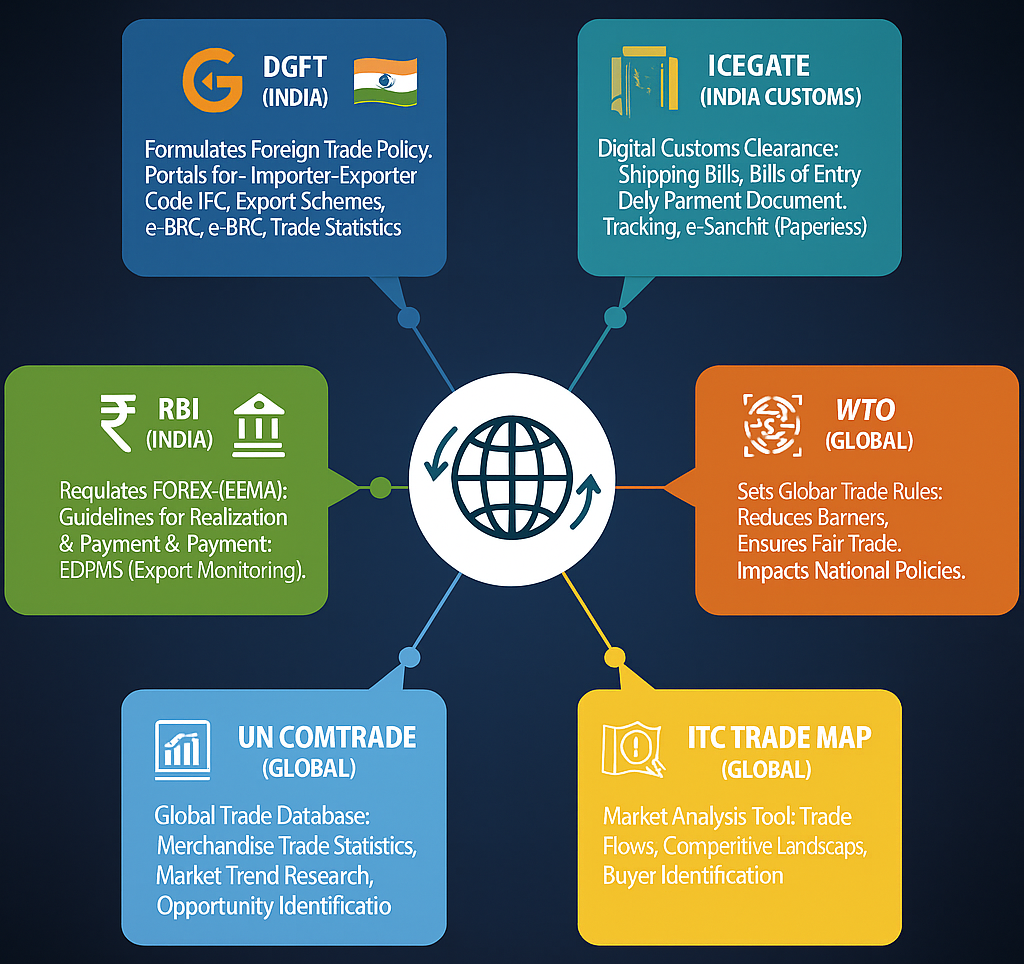
Several key government and international portals facilitate and regulate EXIM trade:
Here are the main types of cargo movement:
DGFT (Directorate General of Foreign Trade): This is the main body in India responsible for formulating, implementing, and guiding the country's Foreign Trade Policy. Exporters interact with the DGFT portal for:
- Obtaining the Importer-Exporter Code (IEC), which is mandatory for international trade.
- Applying for various export promotion schemes and authorizations.
- Managing e-BRC (Electronic Bank Realization Certificate), which confirms the receipt of export proceeds.
- Accessing trade statistics and policy updates.
ICEGATE (Indian Customs Electronic Gateway): This is the digital backbone for customs clearance in India. It provides a single point for importers and exporters to lodge their clearance documents online. Key functions include:
- E-filing of Shipping Bills (for exports) and Bills of Entry (for imports).
- Online payment of customs duties.
- Tracking the status of documents and responding to customs queries.
- E-Sanchit, a facility for paperless document submission.
RBI (Reserve Bank of India): The RBI regulates foreign exchange matters under the Foreign Exchange Management Act (FEMA). Its role in EXIM trade involves:
- Issuing guidelines for the realization and payment of foreign exchange for exports and imports.
- Monitoring export proceeds through the Export Data Processing and Monitoring System (EDPMS).
WTO (World Trade Organization):
- As a global organization, the WTO sets the rules of trade between nations.
- It provides frameworks for reducing trade barriers and ensuring fair trade practices. Information from WTO impacts national trade policies and regulations.
UN Comtrade (United Nations Comtrade Database):
- This is a global database of official international trade statistics.
- It provides detailed data on merchandise trade by commodity and partner country, allowing traders to research market trends and identify potential opportunities.
ITC Trade Map (International Trade Centre Trade Map):
- This online tool offers market analysis by product and country, providing insights into trade flows, market access requirements, and competitive landscapes.
- It's valuable for identifying buyers and understanding market dynamics.
3. Common Bottlenecks for Small Exporters
Small and Medium-sized Enterprises (SMEs) or MSMEs often face specific challenges in navigating the EXIM information and data landscape:
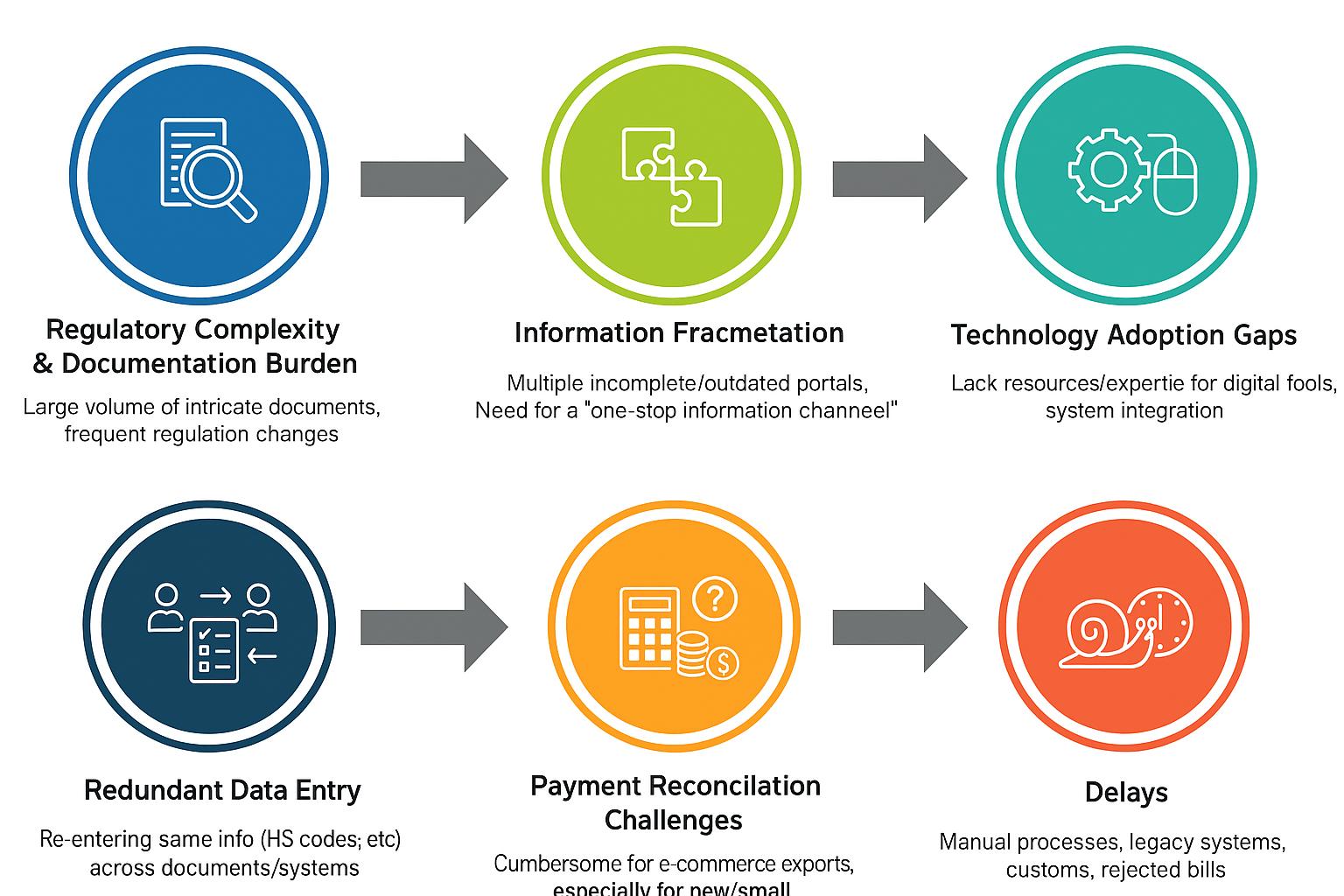
Regulatory Complexity and Documentation Burden
- Exporters, especially new ones, struggle with the large volume and intricate nature of required documents and the frequent changes in regulations.
- Each incentive scheme or type of goods may have different documentation requirements.
Information Fragmentation
- India has multiple portals that may offer incomplete or outdated information, forcing exporters to navigate numerous sources to gather necessary details.
- There is a recognized need for a one-stop information channel
Technology Adoption Gaps
- Smaller exporters may lack the resources or technical expertise to effectively use digital tools and integrate their systems with government platforms, creating competitive disadvantages.
Redundant Data Entry
- Exporters often have to re-enter the same information, such as HS codes, multiple times across different documents and systems (e.g., invoice, shipping bill, bill of entry), leading to inefficiencies and potential errors.
Payment Reconciliation Challenges
- For e-commerce exports, reconciling payments can be particularly cumbersome for new or small exporters.
Delays
- Delays can arise from manual processes, legacy systems, time required for customs reconciliation, or reprocessing rejected shipping bills.
These four flows are the backbone of a resilient and efficient supply chain, ensuring that the right product is delivered in the right quantity, at the right time, at the right cost, to the right customer.
Real-time Case Study: Filing Documents via ICEGATE
Imagine Asha, a small exporter in Surat, India, who has received an order for textiles to be shipped to the USA. Here's how she might use ICEGATE to file her export documents:
Preparation:
- Asha first ensures her firm is established, has a PAN, and an Importer-Exporter Code (IEC), and that her product (textiles) is freely exportable without a specific license.
- She prepares her commercial invoice and packing list with accurate details, including the ITC-HS code for her textiles.
Accessing ICEGATE:
- Asha, or her appointed Customs House Agent (CHA) goods, country of destination, exporter's and importer's addresses, quantity, and value, are entered.
Uploading Documents via e-Sanchit:
- Supporting documents like the commercial invoice, packing list, and certificate of origin are uploaded digitally using the e-Sanchit facility integrated with ICEGATE.
Checklist and Submission:
- A checklist is generated for verification, allowing Asha or her CHA to review the entered data for accuracy.
- After verification, the data is submitted, and the system generates a Shipping Bill Number.
Customs Processing and Query Resolution:
- In many cases, the Shipping Bill is processed automatically by the system.
- However, if the Risk Management System (RMS) flags the consignment, a Customs Officer might order samples for examination.
- Asha or her CHA can check the status of the Shipping Bill and any queries raised by Customs online through the Service Centre and file a reply.
Let Export Order:
- Once all formalities are complete and customs is satisfied, the system issues a "Let Export Order" (LEO), which signifies that the goods are cleared for export.
- A printout of the Shipping Bill with the LEO is taken at this stage.
Shipment and Payment: receive payment and any applicable export incentives.
- With the LEO, the goods can be shipped. Afterward, Asha will negotiate the documents with her bank, linking the Shipping Bill and e-BRC to
This digital process, facilitated by ICEGATE, significantly reduces the need for physical travel to the Custom House, saving time and costs for exporters like Asha.

Exercise for Learners : Exploring Global Trade Data
To better understand global trade flows and how data is presented, please perform the following exercise:
-
Open UN Comtrade or ITC Trade Map:
- You can access UN Comtrade at https://comtrade.un.org/
- You can access ITC Trade Map at https://www.trademap.org/
- Select Your Country: Find your home country (or any country you are interested in) as the reporting country.
- Find Top 5 Exports: Navigate the website to identify the top 5 merchandise export products from your chosen country for the most recent year available. Look for categories that are clearly defined (e.g., not just "miscellaneous").
- Note Down: Write down the names of these top 5 export products and their approximate export values (if available) for that year.
Analysing Trade Data
Understanding trade data is like reading the pulse of a country's economic health and its connections to the rest of the world. For beginners, it might seem complex, but by breaking it down, it becomes much clearer.
1. What is Trade Data?
Trade data refers to information about the buying and selling of goods and services across international borders, a process often shortened to EXIM trade (Export-Import trade).
- Exports are goods or services sold from your country to another country, bringing in foreign currency and boosting local production and jobs.
- Imports are goods or services bought from another country into your country, providing access to products not available domestically or supporting industries reliant on foreign raw materials.
This data includes details like :
- The type of product traded. Products are classified using a Harmonized System of Nomenclature (HSN), which is an internationally accepted numerical classification system developed by the World Customs Organization (WCO). India, for example, uses eight-digit ITC-HS Codes for its import-export operations.
- The value of the trade (how much money was exchanged).
- The quantity or volume of goods (how much physical product was traded).
- The countries involved in the trade (where goods are coming from or going to).
- The time period of the trade (e.g., monthly, quarterly, yearly).
Organizations like India's Directorate General of Commercial Intelligence and Statistics (DGCIS) are responsible for collecting, compiling, and disseminating India's trade statistics. Globally, databases like UN Comtrade provide official international trade statistics, and ITC Trade Map offers market analysis by product and country.
2. How to Check Growth Year by Year
Checking year-on-year growth helps you understand if a country's exports or imports are increasing or decreasing over time. It's a key indicator of economic performance.
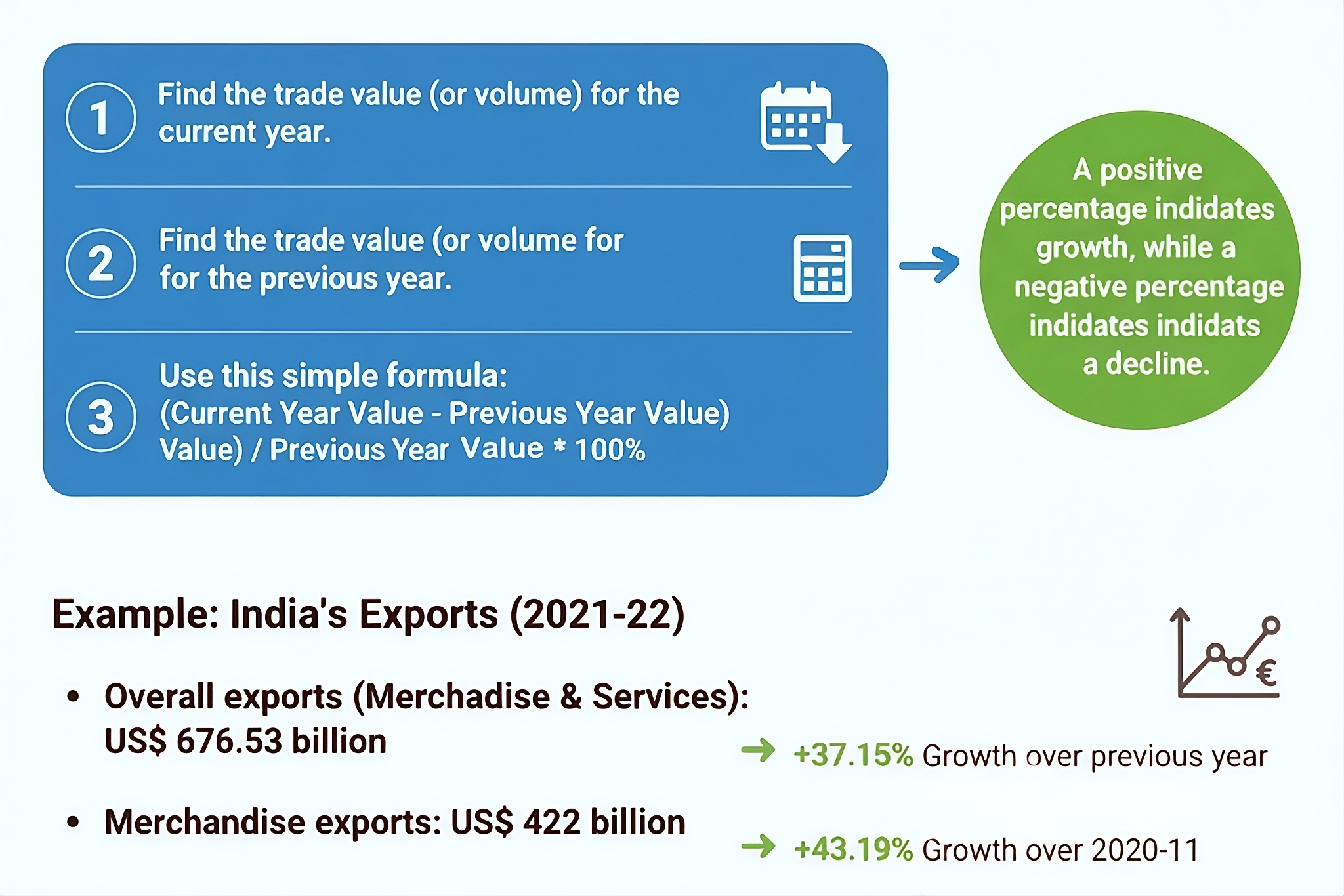
3. How to Compare Volume vs. Value
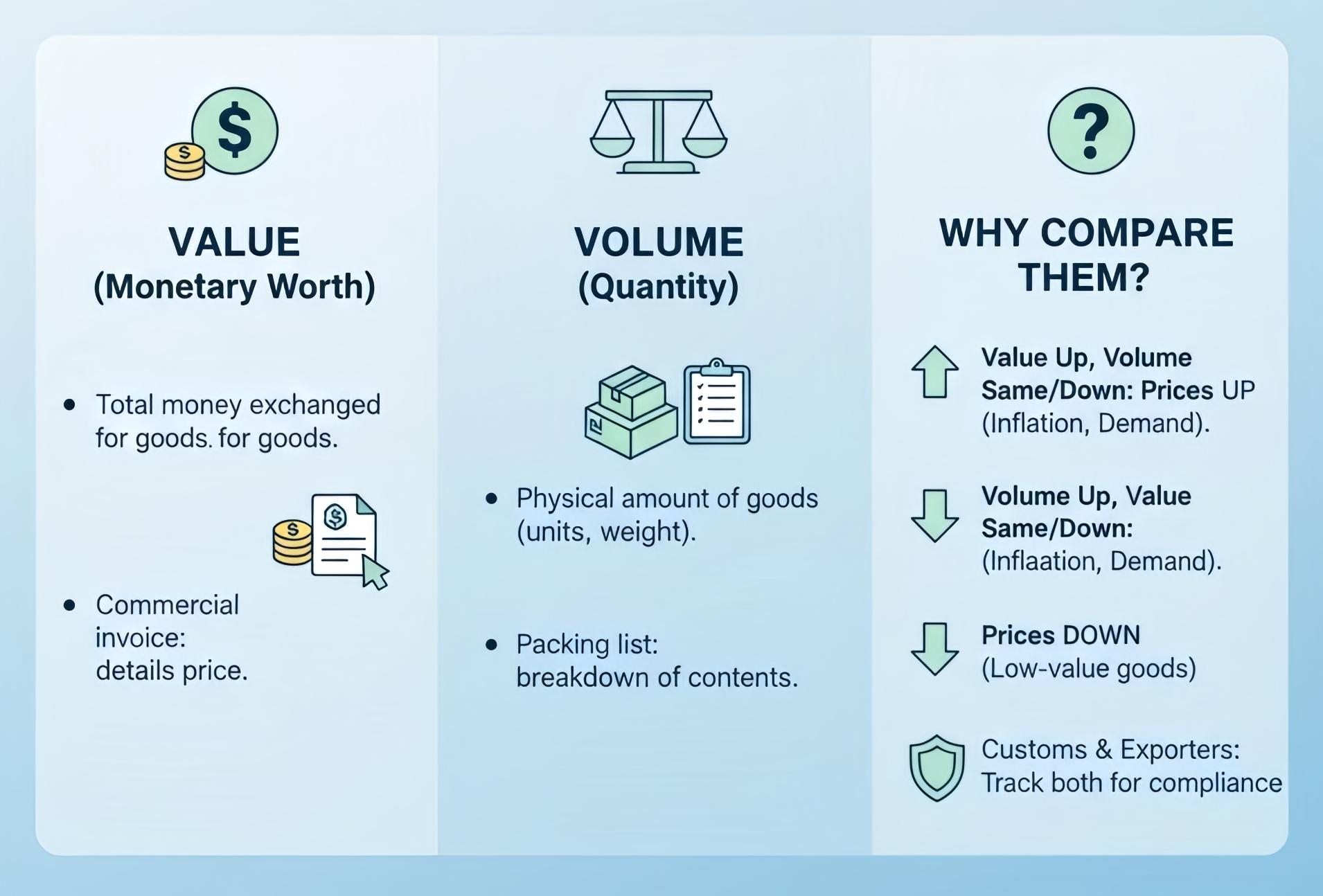
Both volume (quantity) and value (monetary worth) are crucial metrics, and comparing them provides different insights into trade dynamics.
Value (Monetary Worth)
- This tells you the total money exchanged for the goods. A commercial invoice, for instance, details the product's value and unit price.
- High value indicates a significant financial contribution to the economy.
Volume (Quantity)
- This refers to the physical amount of goods traded, such as the number of units, weight, or cubic meters.
- A packing list provides a detailed breakdown of contents and weights.
Why compare them?
- If the value increases significantly but the volume stays the same or decreases, it might indicate that prices for those goods have gone up (e.g., due to inflation, higher demand, or scarcity).
- If the volume increases but the value stays the same or decreases, it could mean that the prices for those goods have fallen, or the country is exporting/importing more low-value goods.
- Customs authorities and exporters often track both quantity and value to ensure compliance with regulations.
Understanding both helps in identifying market trends, pricing strategies, and supply chain efficiency.
4. How to Identify Top Products
Identifying top products helps a country understand its competitive advantages and where to focus its trade policies.
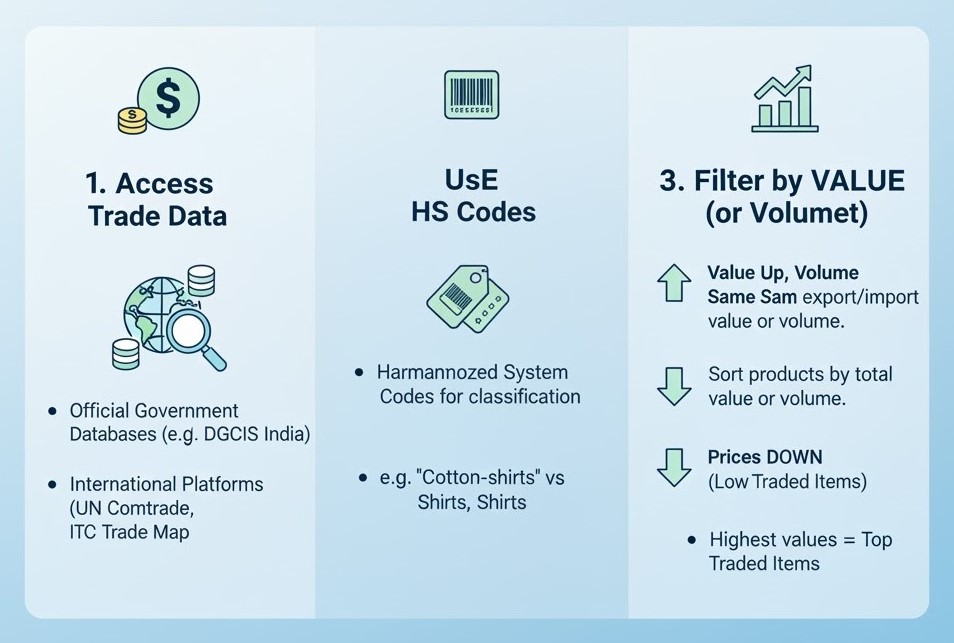
- Access Trade Data Portals: Utilize official government databases like DGCIS in India or international platforms like UN Comtrade and ITC Trade Map. Many of these platforms allow you to filter data by country, year, and product category.
- Use HS Codes: Products are categorized using HS codes (e.g., India's 8-digit ITC-HS Codes). These codes help in granular classification, allowing you to find specific product groups like "cotton T-shirts" instead of just "shirts".
- Filter by Value (or Volume): On these portals, you can typically sort products by their total export or import value (or volume) for a selected year. The products with the highest values represent the top traded items.
Real-time Case Study: India's Top Exports in 2021-22
Let's look at India's major commodities of export for the financial year 2021-22, as indicated by the Ministry of Commerce & Industry:
- Engineering Goods: These include a wide range of manufactured products, from machinery to vehicles, demonstrating India's industrial capabilities.
- Petroleum Products: This category covers refined petroleum products, indicating India's refining capacity and global energy trade participation.
- Gems & Jewellery: This sector, encompassing cut diamonds, gold, and other precious stones and metals, has historically been a significant export for India.
- Organic & Inorganic Chemicals: This includes various chemical compounds essential for different industries globally, showcasing India's chemical manufacturing strength.
- Drugs & Pharmaceuticals: India is known as the "pharmacy of the world," exporting a vast array of medicines and pharmaceutical products.
These top products collectively contributed to India's merchandise exports reaching US$ 422 billion in 2021-22.
Exercise for Learners: Visualizing Trade Data
Now it's your turn to explore trade data!
-
Download a Trade Statistics File:
- Visit DGCIS (Directorate General of Commercial Intelligence and Statistics) for India's official trade data: http://dgciskol.gov.in/. Look for monthly or annual trade reports.
- Alternatively, access World Bank Trade Data: https://databank.worldbank.org/ .
- Choose a Data Set: Select a country (e.g., your home country or India) and a specific year for merchandise exports. Try to find data that lists several top export products and their values.
-
Create a Simple Graph: Open Excel or Google Sheets.
- Input the names of the top 5-10 export products and their corresponding values (or volumes).
- Create a simple bar chart to visualize these exports. This will allow you to quickly see which products have the highest export values.
- Label your axes clearly (e.g., "Export Products" on the X-axis and "Export Value (in USD)" on the Y-axis).
This exercise will give you hands-on experience in extracting and visualizing real-world trade data, helping you understand how these concepts are applied.
Global Trade Ecosystem & Trends
Understanding the global trade ecosystem is essential to grasp how countries interact economically and how goods and services move across borders. This ecosystem involves a network of organizations, agreements, and strategies, all of which can be affected by major global events.
1. Main Organizations
Several key international organizations work to regulate, facilitate, and promote global trade:
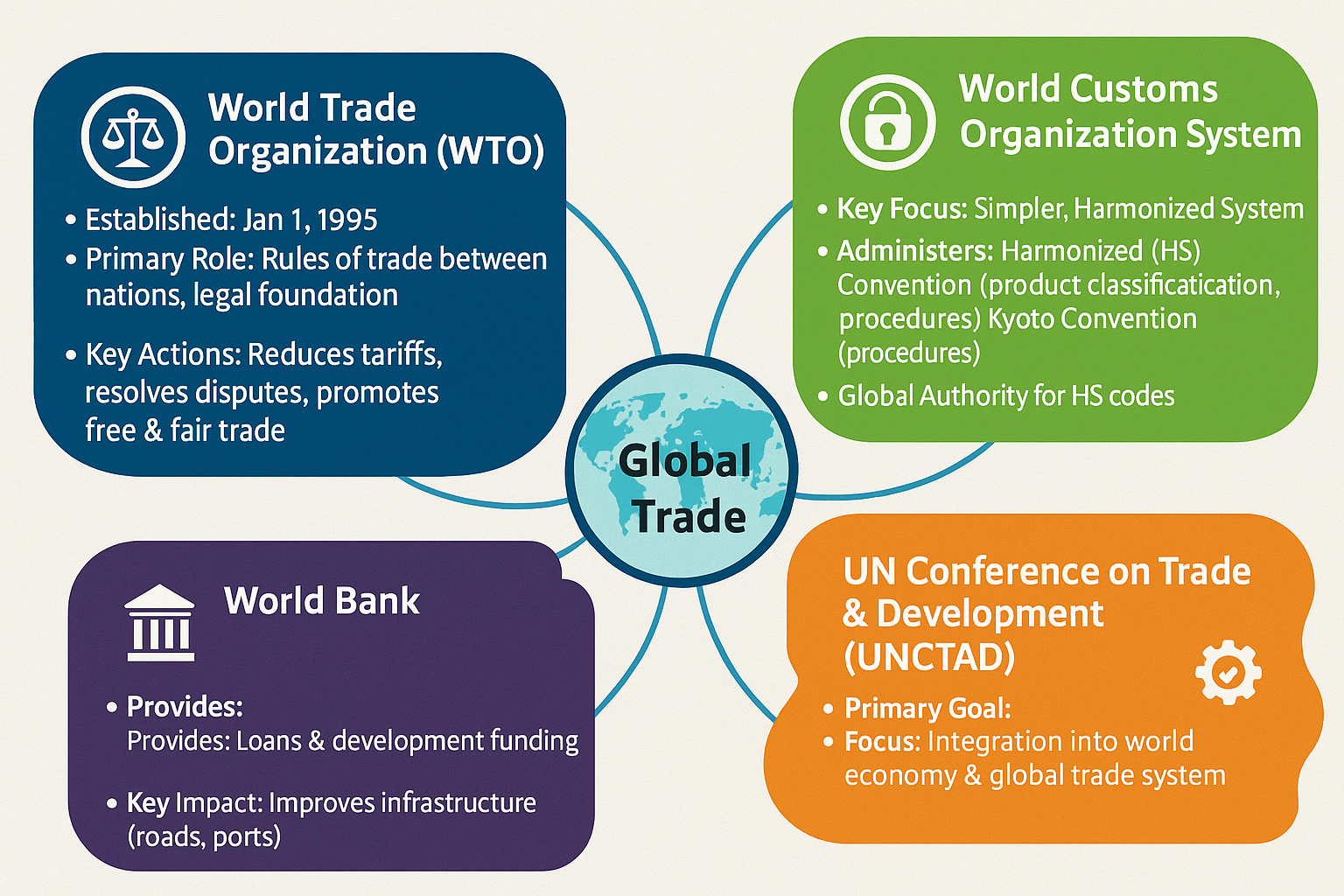
World Trade Organization (WTO):
- Established on January 1, 1995, the WTO is the primary international organization that deals with the rules of trade between nations.
- It provides a legal foundation for international commerce, with agreements negotiated and signed by the majority of the world's trading nations and ratified by their parliaments.
- The WTO's goal is to help producers of goods and services, as well as exporters and importers, conduct their business by reducing tariffs and harmonizing laws and practices that act as trade barriers.
- It also works to resolve trade disputes between countries and promotes free and fair trade.
World Customs Organization (WCO):
- For over 50 years, the WCO has provided leadership in expanding international trade. Its success stems from a clear principle: simpler and harmonized customs procedures lead to greater prosperity for international trade.
- The WCO administers international agreements, such as the Harmonized System Convention, which is the basis for import and export schedules worldwide, and the Kyoto Convention on customs procedures.
- The WCO is also the global authority for HS codes, which are crucial for product classification.
United Nations Conference on Trade and Development (UNCTAD):
- This organization is mentioned as one of the international bodies that plays a role in the international setup.
- While the sources don't detail its functions extensively, generally, UNCTAD aims to support developing countries in integrating into the world economy and global trade system.
World Bank:
- The World Bank provides long-term loans and development funding to improve infrastructure in developing countries. Better infrastructure, such as roads and ports, directly contributes to smoother logistics for exporters and importers.
- It also offers insights into trade and development.
2. Trade Agreements
Trade agreements are formal arrangements between countries or blocs of countries to reduce or eliminate barriers to trade, thereby promoting economic cooperation.
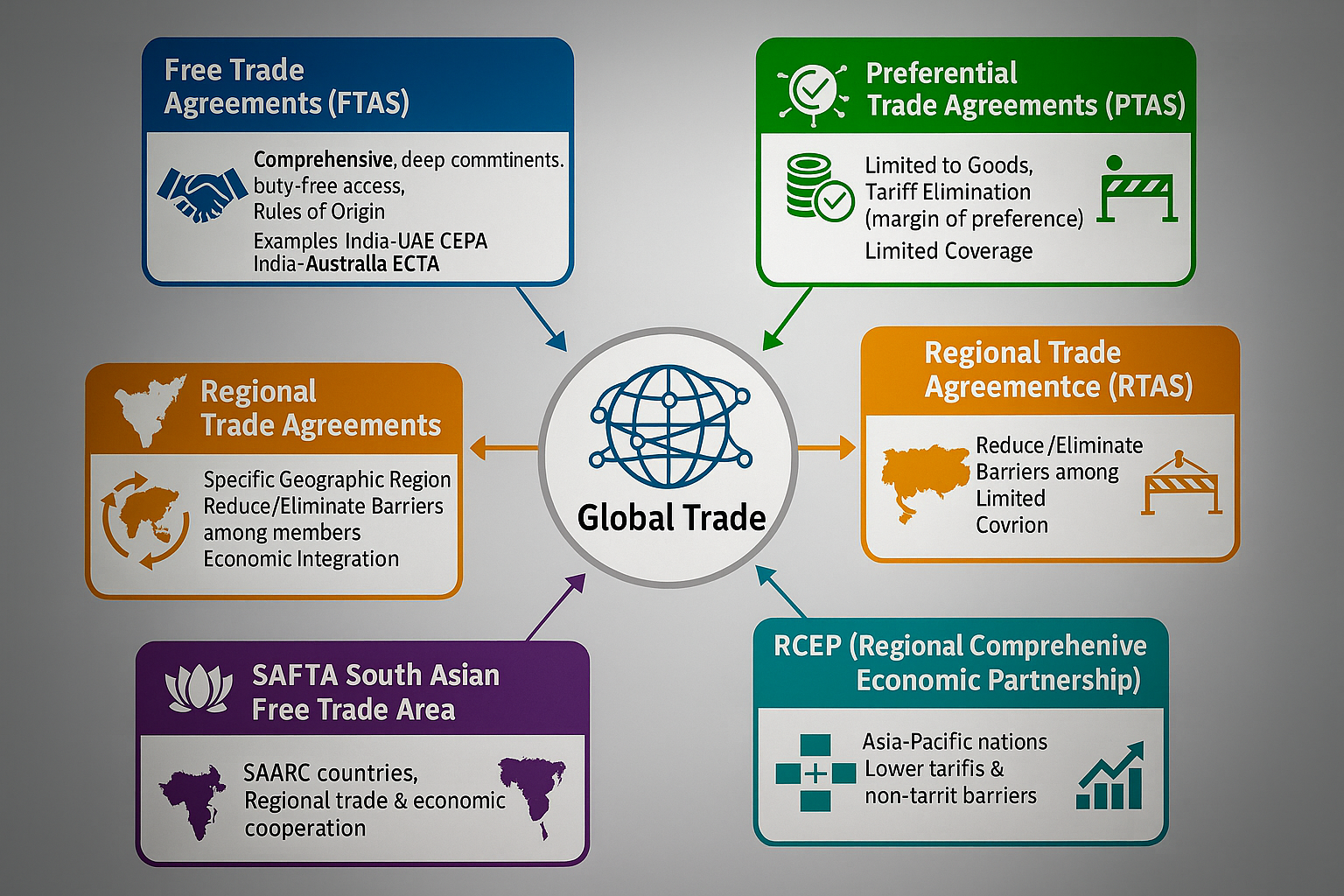
Free Trade Agreements (FTAs):
- These are comprehensive agreements that facilitate trade across a number of areas, often with deeper commitments between member countries.
- They typically lead to duty-free access for goods meeting specific rules of origin. Examples include India's Comprehensive Economic Partnership Agreement with the United Arab Emirates and the India-Australia Economic Cooperation and Trade Agreement.
Preferential Trade Agreements (PTAs):
- PTAs are often confined to trade in goods and primarily seek tariff elimination in terms of a margin of preference. Their coverage on goods is usually more limited compared to FTAs.
Regional Trade Agreements (RTAs):
- These are agreements between countries in a specific geographic region to reduce or eliminate trade barriers among themselves.
- The concept of regionalism encourages economic integration and trade within these blocs, though some view them as potential barriers to outsiders.
SAFTA (South Asian Free Trade Area):
- This is an agreement among the countries of the South Asian Association for Regional Cooperation (SAARC) aimed at promoting trade and economic cooperation in the region.
RCEP (Regional Comprehensive Economic Partnership):
- Mentioned as a trade agreement to learn about, RCEP is a free trade agreement among the Asia-Pacific nations, aiming to lower tariffs and non-tariff barriers.
These agreements are crucial for allowing exporters and importers to utilize concessions and considerations provided by other nations.
3. Major Global Disruptions
International trade is highly susceptible to unexpected events, which can significantly interrupt supply chains and logistics.
COVID-19 Pandemic (2020–2022): The pandemic caused widespread factory shutdowns, especially in China, leading to delayed raw material supplies. It also resulted in global port congestion, causing weeks of shipping delays.
Russia-Ukraine Conflict: This geopolitical conflict has led to global trade disruptions. While specific impacts aren't detailed in the sources, such conflicts typically affect energy markets, commodity prices, and shipping routes.
Suez Canal Blockage (2021): The container ship Ever Given blocked one of the world's busiest trade routes. This event stranded ships carrying oil, machinery, and consumer goods for days, incurring billions in costs. It highlighted the fragility of global supply chains and the importance of critical shipping lanes.
These disruptions necessitate strategies such as diversifying export markets, sourcing from multiple suppliers, and building resilient, flexible supply chains with multi-route logistics.
4. India's Trade Strategies
India employs various strategies to boost its exports and integrate into the global economy:
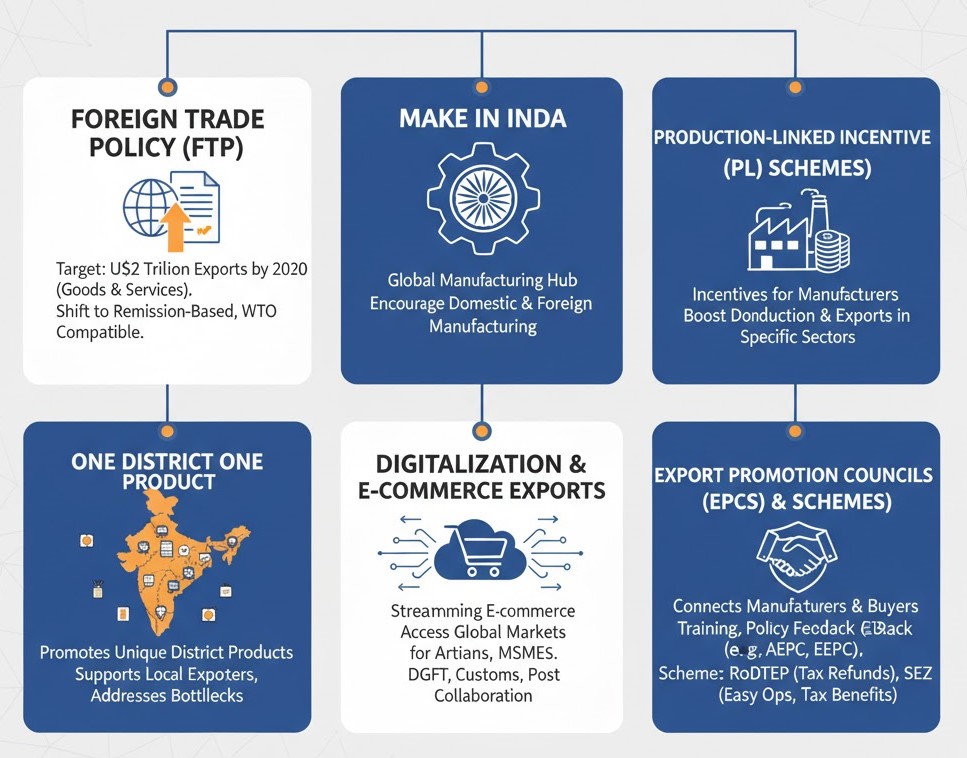
Foreign Trade Policy (FTP):
- India's FTP, such as the 2023 policy, is a dynamic framework aimed at achieving ambitious export targets, like US$2 trillion by 2030, covering both merchandise and services.
- The FTP has shifted from an incentive-based regime to a remission-based one, focusing on competitiveness and WTO compatibility.
Make in India:
- This initiative is aimed at making India a global manufacturing hub.
- It encourages both domestic and foreign companies to manufacture their products in India, which can boost exports and reduce reliance on imports
Production-Linked Incentive (PLI) Schemes:
- These schemes offer incentives to manufacturers, often aimed at specific sectors, to boost domestic production and exports.
One District One Product (ODOP):
- This initiative promotes specific products and services with export potential from each district in India, addressing bottlenecks and supporting local exporters and manufacturers.
Digitalization and E-commerce Exports:
- India is focusing on streamlining e-commerce exports through IT system enablement and special outreach programs for small e-commerce exporters.
- This helps artisans, weavers, and MSMEs in landlocked regions access international markets.
- DGFT is actively promoting e-commerce exports through collaborations with Customs Authorities and the Department of Posts.
- E-commerce offers access to a larger global market and integrated services for sellers.
Export Promotion Councils (EPCs):
- These organizations connect Indian manufacturers with foreign buyers, offer training on compliance and documentation, and provide policy feedback to the government.
- Examples include the Apparel Export Promotion Council (AEPC) and the Engineering Export Promotion Council (EEPC).
Schemes for Export Promotion:
- India offers schemes like RoDTEP (Remission of Duties & Taxes on Exported Products) which refunds certain non-refunded taxes/duties, making goods more competitive globally.
- The Special Economic Zones (SEZs) framework offers easy operations and tax benefits for exporters.
Real-time Case Study: The Suez Canal Blockage (2021)
The Suez Canal, a vital man-made waterway in Egypt, connects the Mediterranean Sea to the Red Sea, offering the shortest sea route between Europe and Asia. In March 2021, the container ship Ever Given became wedged across the canal, effectively blocking traffic in both directions.
Impact of the Blockage:
- Shipment Delays: Hundreds of ships were stuck, causing immense delays for goods ranging from crude oil and consumer products to machinery. These delays rippled through global supply chains, impacting deliveries worldwide.
- Increased Costs: Companies faced higher freight and warehousing costs due to rerouting around Africa (which significantly extends transit time) or paying demurrage charges while waiting for the canal to clear.
- Supply Shortages: The delays led to shortages of raw materials and finished goods in various industries, disrupting production schedules and retail availability.
- Global Awareness: The incident brought global attention to the fragility and interconnectedness of modern supply chains, emphasizing the need for resilience and alternative strategies.
This event served as a stark reminder of how a single choke point in global logistics can have massive economic repercussions worldwide.
Exercise for Learners
- Choose a Report/Article: Visit the World Trade Organization (WTO) website www.wto.org or the World Bank website databank.worldbank.org.
- Read and Identify: Select one recent article or report (e.g., a "Trade Policy Review Report" from WTO, or a "Trade and Development Report" from the World Bank).
- Summarize a Global Trend: After reading, write a short paragraph (100-150 words) describing one major global trade trend or challenge that you found in the document. Explain why you think this trend is significant for the future of international trade.