Introduction to Exim
The guide takes a structured approach to explaining international trade in simple English, with a mix of concepts, real-world case studies, and practical exercises. Each section is designed for learners who are new to the subject, including non-native English speakers, and follows a step-by-step progression from “what EXIM is” to “how it works in India” to “hands-on practice with documents and codes”.

Understanding EXIM Trade
EXIM trade is simply the buying and selling of goods and services between different countries. It's a key part of how countries work together in the global economy.
1. What is EXIM Trade ?
- EXIM is a short way to say "Export and Import".
- It means that people and companies in one country sell things to people and companies in other countries (exports), and they also buy things from other countries (imports).
- This helps countries get things they don't have and sell things they are good at making.
2. Exports
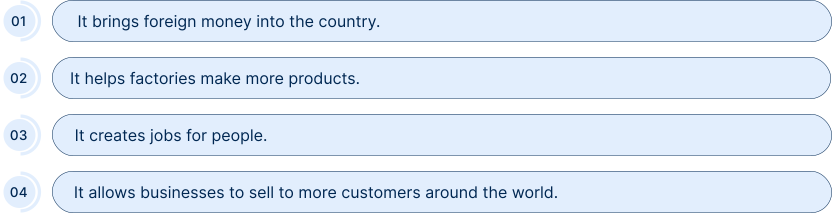
What it is: When a country sells its goods or services to another country, it's called an export. This is like sending things "out of" your country.
Example: If a company in India makes clothes and sells them to a customer in the USA, India is exporting textiles. India also exports computer services (IT services), jewelry, and medicines (pharmaceuticals).
3. Imports
What it is: When a country buys goods or services from another country, it's called an import. This is like bringing things "into" your country.
Example: If a country like India needs oil, it might import crude oil from a country like Saudi Arabia. India also imports machines (machinery), electronics, gold, and fertilizers.

4. Balance of Trade vs. Balance of Payments
These are ways to measure how much a country exports and imports.
Balance of Trade (BOT)
- This is the difference between the total value of what a country exports and what it imports.
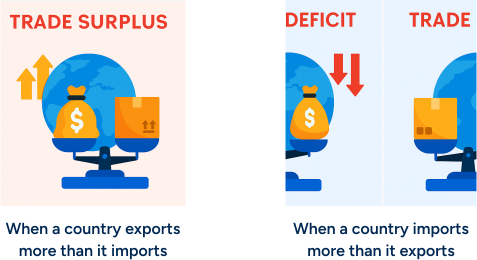
- Trade Surplus: If a country exports more than it imports, it has a "trade surplus". This usually means more foreign money comes in than goes out.
- Trade Deficit: If a country imports more than it exports, it has a "trade deficit". This can mean more foreign money leaves than comes in. For example, India often imports more than it exports, leading to a trade deficit.
- The Balance of Trade affects a country's money value (currency) and its economy.
Balance of Payments (BOP)
- This is a bigger picture than the Balance of Trade.
- It includes not only the buying and selling of goods (Balance of Trade) but also services (like tourism or computer services) and other money flows between countries.
- It shows all economic transactions a country has with the rest of the world.
5. Why EXIM Matters
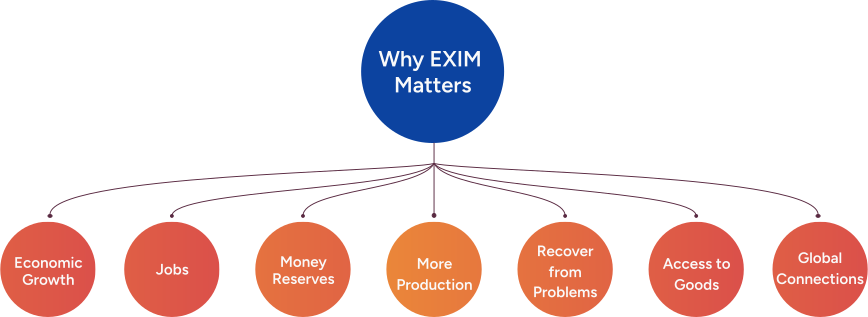
EXIM trade is very important for many reasons:
Economic Growth: It helps a country's economy grow and brings in foreign money.
Jobs: It creates more jobs for people in different industries.
Money Reserves: It increases a country's savings of foreign money.
More Production: It encourages local businesses to make more goods and services.
Recover from Problems: It can help a country get out of economic difficulties.
Access to Goods: It allows countries to get important items they cannot produce themselves.
Global Connections: It connects countries and helps them work together.
Real-Time Case Study: India Managing Trade
Let's look at India as an example:
India's Exports (Textiles & IT Services):
- Imagine a textile company owner, Asha, in Surat, India. She receives an order from John, a buyer in the USA, for many cotton shirts.
- They agree on the price and shipping details. Asha checks that she has all the necessary export permissions (licenses) and then makes the shirts.
- She ensures the quality is good and gets a loan from a bank to help pay for materials and workers before the shirts are shipped.
- A freight forwarder helps Asha with packing, marking, and transporting the shirts to Mumbai Port.
- At the port, customs officials check the goods and documents before allowing the shipment.
- Once the shirts are on the ship, Asha gets a document called a Bill of Lading, which proves the goods have been sent.
- John pays Asha's bank, often using a Letter of Credit, which is a bank guarantee for payment
- The shirts arrive in the USA, John gets his order, Asha gets paid, and India earns foreign money from exporting.
- Besides textiles, India also exports many IT (Information Technology) services to the world.
India's Imports (Crude Oil):
- Now, imagine Raj, who owns an oil refinery in India. He needs raw oil (crude oil) to make fuel for cars and other uses.
- He finds a supplier in Saudi Arabia and agrees on a price and terms.
- Raj checks if he needs an import license for oil (some goods do) and arranges with his bank to pay in foreign currency.
- The supplier in Saudi Arabia ships the oil. When the oil arrives at an Indian port, Raj's agent submits a document called a Bill of Entry to customs, declaring what is being imported.
- He pays the import taxes (duties). After customs clearance, the oil is moved to Raj's refinery.
- This way, Raj gets the raw material he needs, Indian people get fuel, and Saudi Arabia earns foreign money from exporting its oil.
- India's major imports also include machinery, electronics, gold, and fertilizers.

Exercise for Learners
To understand EXIM trade in your own country:
1. Find your country's government trade portal online. (For example, in India, you can use the "Indian Trade Portal" or the "Indian Customs Compliance Information Portal" (CIP).)
2.Look for information about your country's main exports What goods or services does your country sell a lot of to other countries?
3.Look for information about your country's main imports. What goods or services does your country buy a lot of from other countries?
Note down one major export item and one major import item for your country.
Understanding India’s EXIM Ecosystem
EXIM trade (short for Export-Import trade) is about countries buying and selling things to each other. India's EXIM ecosystem is like a big network of people, companies, and government offices that work together to make this trade happen smoothly.
1. Main Players in India's EXIM Ecosystem
Several important players make EXIM trade possible in India:
Exporters
These are people or companies in India that sell goods or services to other countries. For example, a company in India selling cotton shirts to the USA.
Importers
These are people or companies in India that buy goods or services from other countries. For example, a company in India buying crude oil from Saudi Arabia.
Banks
Banks are very important for handling money in EXIM trade. They help with payments, foreign currency exchange, and loans for exporters and importers.
Customs
This is a government authority that checks goods entering or leaving India. They make sure all rules are followed and collect taxes (duties) on imported goods.
Government
The Indian government sets the rules and policies for EXIM trade to help the country's economy grow. Different departments handle different parts of trade.
Freight Forwarders
These are companies that help arrange the transport of goods (like booking ships or planes) and manage all the difficult logistics to move goods from the seller to the buyer.
CHAs
Customs House Agents are experts who help exporters and importers complete customs paperwork and get their goods cleared by the Customs department.
2. Roles of the Main Players
Exporters and Importers are the main people who buy and sell things across borders. They decide what to trade, with whom, and on what terms.
Banks help with financing (giving loans for pre-shipment and post-shipment needs) and ensure that foreign currency payments are received correctly and on time. They also issue Letters of Credit (LC), which are bank guarantees to help sellers get paid.
Customs inspects goods, verifies documents, collects customs duties, and grants clearance for goods to enter or leave the country. They use electronic systems like ICEGATE for faster processing.
The Government makes rules and policies (Foreign Trade Policy - FTP) to promote exports and manage imports. It also provides incentives and support to businesses involved in trade.
Freight Forwarders manage the physical movement of goods from the exporter's factory to the importer's warehouse, including packaging, marking, selecting transport modes (sea, air, land), and getting necessary transport documents like a Bill of Lading.
Customs House Agents (CHAs) are crucial for handling complex paperwork for customs clearance, like filing the Shipping Bill for exports or the Bill of Entry for imports.
3. How India Regulates Trade
India has a strong system to manage and promote its EXIM trade.
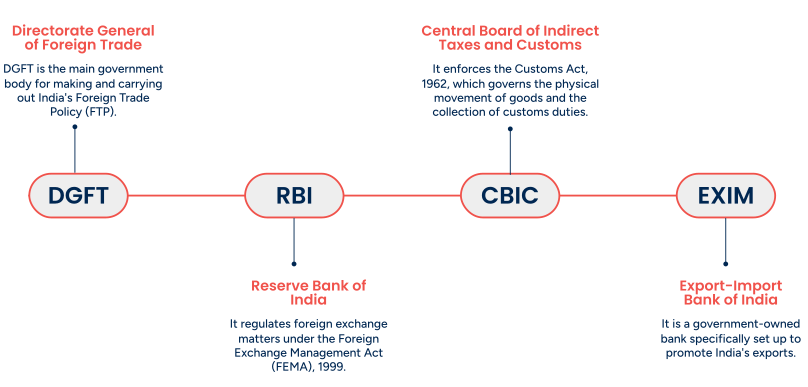
Directorate General of Foreign Trade (DGFT)
- It issues the Import Export Code (IEC), which is a mandatory 10-digit number for all businesses that want to import or export from India.
- DGFT also handles licensing for certain goods and manages export incentive schemes.
- They work to simplify procedures and reduce paperwork to make trade easier.
- The Niryat Bandhu Scheme by DGFT helps train exporters and promotes e-commerce exports.
Reserve Bank of India (RBI)
- It sets rules for how exporters must receive payments (export proceeds) in foreign currency and within specific time limits (e.g., usually within nine months from the date of export).
- RBI issues guidelines for banks (called Authorised Dealer banks) that handle foreign exchange transactions
Central Board of Indirect Taxes and Customs (CBIC)
- They manage customs clearance procedures for both imports and exports.
- The Indian Customs Electronic Data Interchange System (ICES), also known as ICEGATE, is a digital platform by CBIC that allows traders to file documents and exchange information electronically, making customs clearance faster and paperless.
- The Customs Compliance Information Portal (CIP) by CBIC provides complete information on import and export requirements.
Export-Import Bank of India (EXIM Bank)
- EXIM Bank is a government-owned bank specifically set up to promote India's exports.
- They manageIt provides loans and credit to exporters (both before and after shipment). customs clearance procedures for both imports and exports.
- It also helps Indian companies set up offices or projects in other countries.
4. Support Policies for EXIM Trade
The Indian government offers various schemes and policies to help exporters and importers.
Foreign Trade Policy (FTP)
This is the main framework that outlines all the rules, regulations, and incentives for India's foreign trade. The latest policy (FTP 2023) aims to make India a major global trading nation and reach USD 2 trillion in exports by 2030, with a focus on e-commerce exports and engaging states and districts.
Remission of Duties and Taxes on Exported Products (RoDTEP) Scheme
This scheme refunds hidden taxes and duties that exporters paid during the production process and are not otherwise refunded. This helps make Indian products more competitive globally.
Merchandise Exports from India Scheme (MEIS)
This older scheme (now largely replaced by RoDTEP) provided financial assistance to exporters of goods in the form of transferable duty credits.
Export Promotion Capital Goods (EPCG) Scheme
This allows exporters to import machinery and equipment without paying customs duty to produce quality goods and services for export.
Advance Authorisation Scheme
This scheme allows duty-free import of raw materials or inputs that are used to make products that will be exported.
Duty Drawback Scheme
This scheme provides a refund of customs and excise duties paid on raw materials and other inputs used in making exported products.
Special Economic Zones (SEZs)
These are special areas in India that offer tax exemptions and simplified rules to companies that focus on exports.
Export Promotion Councils (EPCs)
These are industry-specific groups that support exporters by giving market information, organizing trade shows, offering training, and providing feedback to the government.
Real-Time Case Study: India Managing Trade
Let's imagine Asha, a textile manufacturer from Surat, India, who wants to export cotton bedsheets to Germany and avail government benefits.
- Finding a Buyer & Contract: Asha finds a buyer in Germany, and they finalize a contract for 5,000 cotton bedsheets, agreeing on the price and delivery terms (e.g., using INCOTERMS like FOB Mumbai Port).
- Getting Ready for Export: Asha's factory produces the bedsheets, ensuring they meet quality standards and are properly packaged and marked. She ensures her company has a valid Import Export Code (IEC) from DGFT.
- Appointing Agents & Documentation: Asha appoints a freight forwarder and a Customs House Agent (CHA) to handle logistics and customs paperwork. Her CHA prepares crucial documents like the Commercial Invoice, Packing List, Certificate of Origin, and the Shipping Bill.
- Customs Clearance & Shipment: The CHA files the Shipping Bill electronically through ICEGATE. Customs officers verify the documents and, if needed, inspect the goods. Once cleared, a "Let Export Order" (LEO) is issued. The bedsheets are then shipped from Mumbai port to Germany.
- Receiving Payment & Claiming Benefits: After the goods are shipped, Asha's bank helps her receive payment from the German buyer, often using an Electronic Bank Realization Certificate (e-BRC) to confirm the payment. This e-BRC is automatically transmitted to DGFT.
- To claim export incentives like RoDTEP, Asha (or her CHA) links the relevant Shipping Bills and the e-BRC to her online application on the DGFT portal.
- The DGFT system processes her application, and if everything is correct, the eligible refund for duties and taxes is granted, helping Asha reduce her costs and make her products more competitive.
Exercise for Learners
To learn more about India's EXIM ecosystem:
1. Open the DGFT portal: Go to https://dgft.gov.in
- Look for a section related to "Services" or "Learn." Can you find a service that DGFT provides, like "IEC Profile Management" or "Export Import Guide"? Note down one service
2. Open the ICEGATE portal: Go to https://dgft.gov.in
- Look for a section like "Services" or "Enquiry." Can you find a service that ICEGATE provides, such as "E-filing of Bill of Entry/Shipping Bill" or "Track your document status"? Note down one service.
Understanding HS and HSN Codes in International Trade
Imagine you're sending a package to a friend in another country. To make sure it gets there, you write down your friend's address. In international trade, products also need an "address" so that customs officials and tax authorities know exactly what's being shipped. These "addresses" for products are called HS Codes and HSN Codes.
1. What are HS and HSN Codes?
HS Code (Harmonized System Code): Think of this as the universal language for products in global trade.
- It's a 6-digit numerical code that helps customs authorities around the world classify and identify products.
- The World Customs Organization (WCO) created and manages this system, and it's used by over 200 countries and economies for most traded goods.
- The HS system helps everyone involved in trade, from governments to businesses, speak the same "product language".
HSN Code (Harmonized System of Nomenclature Code): This is India's version of the HS Code, with more specific details.
- While the first 6 digits are the global HS Code, India adds two more digits, making it an 8-digit code. These extra digits help India classify products even more precisely for things like taxes (GST) and national trade policies.
- Other countries also add extra digits to the 6-digit HS Code for their own specific needs. For example, the USA uses a 10-digit code called HTS (Harmonized Tariff Schedule).
2. Why HS and HSN Codes are Important
These codes are crucial for many reasons, directly impacting businesses involved in EXIM trade.
Duty and Tax Calculation: The HS/HSN code directly tells customs officials what taxes (duties) need to be paid on imported goods. Different codes mean different tax rates.
Trade Agreement Benefits: If your product has the correct HS/HSN code, it might qualify for lower or even zero taxes under special trade agreements (like Free Trade Agreements - FTAs) India has with other countries. This can save a lot of money.
Regulatory Compliance: The codes help ensure your products meet all the rules and restrictions for importing or exporting. Some goods might need special licenses or are even banned, and the code helps identify this.
Statistical Tracking: Governments use these codes to track what's being traded, helping them understand economic trends and make informed decisions.
Avoiding Problems: Using the wrong code can lead to big issues, like fines, delays, or even your goods being seized by customs. Getting it right helps ensure smooth customs clearance.
Documentation: HS codes are mandatory on many important documents like commercial invoices, packing lists, bills of lading, and certificates of origin.
3. How to Read HS and HSN Codes (Chapter → Heading → Sub-heading)
HS codes are structured like a tree, starting broad and getting more specific.
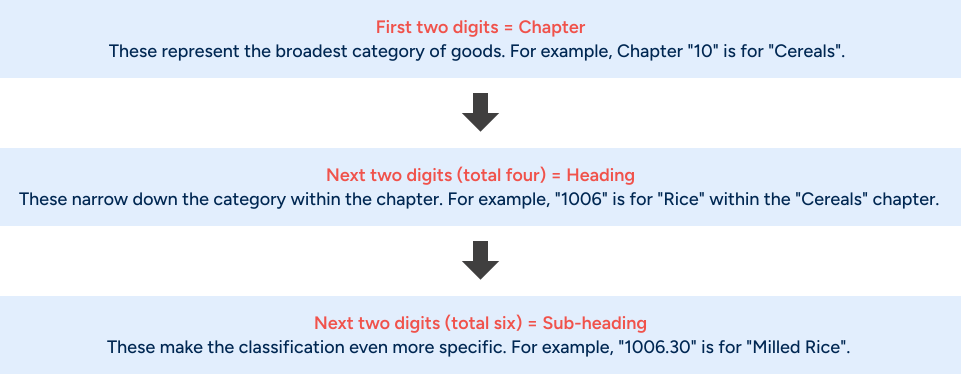
In India, two more digits are added (total eight) = Regional Tariff/National Classification
These provide the most detailed classification for India's specific tax and trade requirements. For example, "1006.30.10" might be for a specific type of Basmati Rice.
4. How They Connect with GST and Customs Duty
In India, HSN codes are key for both Goods and Services Tax (GST) and customs duties.
GST (Goods and Services Tax): When you sell goods within India, the HSN code determines the GST rate. Businesses with a certain turnover must use HSN codes on their invoices (e.g., 6-digit codes are mandatory for turnover above ₹5 crore, and 8-digit codes for turnover above ₹50 crore). This ensures the correct GST is applied.
Customs Duty: When goods are imported into India, the HSN code is used to calculate various customs duties.
- This typically involves the Basic Customs Duty (BCD), a Social Welfare Surcharge (SWS) on the BCD, and the Integrated GST (IGST), which is applied on the total value including CIF (Cost, Insurance, Freight) and other duties.
- For example, if machinery valued at ₹10 lakh is imported with an ITC-HS code of 8423.90.00, it might face a BCD of 7.5%, an SWS of 10% on BCD, and an IGST of 18% on the total value.
Real-Time Case Study: India Managing Trade
Let's follow an Indian exporter, Rohan, who makes cotton T-shirts in India and wants to export them to the USA.
- Finding the HSN Code: Rohan would first find the correct HSN code for his "cotton T-shirts." According to the sources, the HSN for cotton T-shirts is 6109.10.90.
- Deconstructing the Code:
- 61: This is the Chapter for "Articles of Apparel and Clothing Accessories, Knitted or Crocheted".
- 6109: This is the Heading for "T-shirts, singlets and other vests, knitted or crocheted"
- 6109.10: This is the Sub-heading specifically for "Of cotton".
- 6109.10.90: These last two digits are India's specific classification, further detailing the "other" cotton T-shirts.
- Trade and Tax Implications:
- GST: When Rohan sells these T-shirts within India, their HSN 6109.10.90 would typically correspond to a 5% GST rate. This is essential for his domestic invoices.
- Customs Duty (for imports): If Rohan were importing cotton T-shirts, this HSN might have a Basic Customs Duty (BCD) of 20%. The correct classification ensures the right import duties are paid and prevents penalties.
- Trade Benefits (Rules of Origin): If Rohan wants to export to a country with which India has an FTA, he would need to ensure his cotton T-shirts meet the "Rules of Origin" defined for the 6109.10.90 code. This might involve checking if the cotton used (an input) also has a "change of commodity code" from its raw form to the final T-shirt, making the T-shirt eligible for preferential (lower) tariffs in the destination country.
- 6109.10.90: These last two digits are India's specific classification, further detailing the "other" cotton T-shirts.
By using the correct HSN code, Rohan can ensure he charges the right GST for domestic sales, understands the customs duties if he imports, and can claim potential benefits when exporting, making his business compliant and competitive
Exercise for Learners
To practice finding HSN codes:
- Open the CBIC portal: Go to
https://services.gst.gov.in/services/searchhsnsac
(This is India's official government portal for HSN/SAC codes). - Alternatively, you can explore the World Customs Organization (WCO) trade tools for the global 6-digit HS codes. While a direct "search tool" might be behind a paywall, you can often browse their chapters and headings to understand the structure (e.g., via their HS System overview page or similar resources linked on WCO.org).
- Find the HSN/HS code for three products of your choice. Examples could be:
- Coffee beans
- Aluminum foil
- Pharmaceutical products (e.g., specific medicine tablets)
- Mobile phone accessories
- Wooden furniture
- For each product, try to identify its:
- Chapter (first 2 digits)
- Heading (first 4 digits)
- Sub-heading (first 6 digits)
- (If using an Indian portal) The full 8-digit HSN code.
Export & Import Procedures
Export & Import Procedures (India-Specific)
1. IEC Registration (Importer-Exporter Code)
The Importer-Exporter Code (IEC) is the foundational step for anyone looking to engage in international trade in India.
- What it is: The IEC is a 10-digit alphanumeric code issued by the Directorate General of Foreign Trade (DGFT). It is a mandatory pre-condition for importing into or exporting from India
- Purpose: This unique code, based on your Permanent Account Number (PAN), is essential for clearing customs, sending shipments, and making or receiving payments in foreign currency. It also enables you to import or export any item that is not prohibited.
- Application: The process to obtain an IEC is entirely online via the DGFT website (www.dgft.gov.in). You need to fill out an application form (ANF 2A) and pay a fee. It has lifetime validity and generally does not require renewal.
- Exemptions: While mandatory for commercial trade, certain entities like government ministries/departments or individuals importing/exporting goods for personal use (not connected with trade, manufacture, or agriculture) are exempted from obtaining an IEC. Additionally, specific low-value trade with Nepal, Myanmar, and China (through certain border ports) may also be exempt under specific value limits.
2. Pre-Shipment Process (for Exporters)
Once the IEC is obtained, an exporter moves to prepare the goods for shipment.
1. Market Research & Order Confirmation: First, the exporter identifies target countries and potential buyers, studies demand, and checks competition. After receiving an export order, it must be carefully examined and confirmed for details like items, specifications, payment terms (e.g., FOB, CIF), packaging, and delivery schedules. A formal contract is then entered with the overseas buyer.
2. Product & Licensing Check: The exporter must verify if the goods require any special licenses or government approval. Some goods are "free" (no license needed), some are "restricted" (require an export license), and others are "prohibited" (cannot be exported at all) or "canalized" (exported only through designated agencies). Examples of restricted items are certain special chemicals, organisms, materials, equipment, and technologies (SCOMET items).
3. Procurement / Manufacture & Quality Control: The goods are either produced or procured according to the buyer's specifications. Quality checks are critical to ensure the goods meet standards, with some products requiring compulsory pre-shipment inspection.
4. Finance: Exporters can obtain pre-shipment finance (like packing credit) from commercial banks at concessional interest rates to cover expenses such as raw materials, processing costs, and packing.
5. Packaging, Labeling, and Marking: Goods must be properly packed, labeled, and marked, adhering strictly to the importer's instructions. Correct packaging protects goods, while marking (e.g., consignee, destination, weight, country of origin) provides identification and information.
6. Excise Clearance (if applicable): Before dispatching to the port, exporters may need to secure clearances from Central Excise authorities, especially for excisable goods. Exporters generally do not bear the burden of excise duty on inputs or the final product for exports; it is either exempted or refunded. The ARE-1 form is used for this process.
7. Insurance: Marine insurance covers risks of loss or damage during transit. In CIF (Cost, Insurance, and Freight) contracts, the exporter typically arranges the insurance.
3. Post-Shipment Process (for Exporters)
After the goods are shipped, the focus shifts to documentation and payment collection.
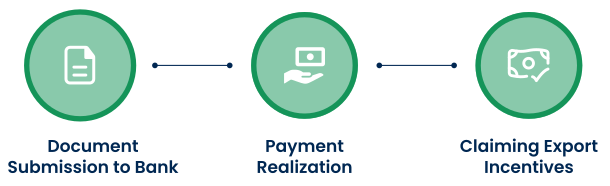
1. Document Submission to Bank: The exporter must present all relevant shipping documents to an Authorized Dealer (AD) Bank for negotiation or collection, usually within 21 days from the date of shipment. These documents typically include the Bill of Exchange, Bill of Lading/Airway Bill, Commercial Invoice, Packing List, Certificate of Origin, and foreign exchange forms (GR/SDF/SOFTEX/PP Forms).
2. Payment Realization: Export proceeds should be realized through an AD Bank, preferably in a freely convertible currency, and generally within nine months from the date of export. In cases of delay, an extension can be sought from the RBI if the reasons are beyond the exporter's control.
3. Claiming Export Incentives: India offers various incentives to promote exports, such as the Remission of Duties and Taxes on Exported Products (RoDTEP) scheme and the Advance Authorization Scheme. Exporters can claim these benefits through DGFT portals.
4. Customs Clearance
Customs clearance is a mandatory step for both exports and imports, regardless of the mode of shipment. The Central Board of Indirect Taxes and Customs (CBIC) regulates this process.
For Exports:
- Shipping Bill: For goods shipped by sea or air, customs permission is granted on a document called a Shipping Bill. For road/rail, it's a "Bill of Export". The Shipping Bill is electronically filed via the Indian Customs Electronic Data Interchange (EDI) System (ICES)/ICEGATE portal.
- Documentary Verification: Customs authorities examine documents like the Shipping Bill, Commercial Invoice, Packing List, Certificate of Origin, and Exchange Control Declaration Form (GR form/SDF form) to ensure compliance with quality control, exchange control, and licensing requirements.
- Physical Examination: Customs officers may physically examine the goods, particularly if flagged by the Risk Management System (RMS) (typically 3-5% of shipments).
- "Let Export Order": If satisfied, customs issues a "Shipping Bill Number" and, after verification, the "Let Export Order" (LEO), which authorizes the goods for loading.
For Imports:
- Import General Manifest (IGM): The carrier (ship, aircraft) carrying imported goods must deliver an IGM to customs within 24 hours of arrival.
- Bill of Entry: Importers are required to file an Import Declaration in the prescribed Bill of Entry along with a PAN-based Business Identification Number (BIN). The Bill of Entry contains details about the importer, the goods (description, quantity, value, classification), and the import duty payable. For EDI system clearances, no formal paper Bill of Entry is filed as it's generated electronically.
- Assessment & Duty Payment: Customs officials examine the information in the Bill of Entry and assess import duty rates. India levies Basic Customs Duty (BCD) and other goods-specific duties, as specified in the Customs Tariff Act, 1975. Once assessed, the importer pays the applicable duties and taxes, which may include Integrated GST (IGST), as per the HSN classification.
- "Pass Out Order": If there are no irregularities, customs issue a "pass out order" allowing the imported goods to be released.
| For Exports | For Imports |
|---|---|
| Shipping bill | Import General Manifest (IGM) |
| Documentary Verification | Bill of Entry |
| Physical Examination | Physical Examination |
| "Let Export Order" | Pass Out Order |
5. Role of Freight Forwarders and Customs House Agents (CHAs)
These specialized professionals play a vital role in simplifying international trade for businesses.
Clearing and Forwarding Agents (C&F Agents) / Freight Forwarders : These are experts in distribution logistics, managing the physical flow of goods from the exporter's location to the importer's, aiming for efficiency and minimal cost. They:
- Guide exporters on transport routes, costs, and selection of mode/route.
- Secure shipping space and arrange for inland carriers.
- Provide information on freight costs, consular fees, and insurance.
- Assist with proper packaging and containerization of cargo.
- Handle many procedural and documentary formalities required for shipment.
Customs House Agents (CHAs): Also known as freight forwarders, CHAs are professionals authorized to act on behalf of exporters and importers for customs clearance. They:
- Have extensive knowledge of laws and regulations governing the shipment of goods through customs.
- Prepare and file customs documents like the Shipping Bill (for exports) and Bill of Entry (for imports) electronically.
- Represent the exporter/importer before customs authorities for examination and assessment.
- Coordinate with port authorities for cargo movement.
- Can register IECs, CHA licenses, and bank accounts in Customs Computer Systems.
Both freight forwarders and CHAs are critical for ensuring smooth customs clearance and avoiding costly delays or penalties.
Real-Time Case Study: India Managing Trade
Let's imagine "Woody Wonders," a small business in Jaipur, India, that specializes in handmade wooden toys. This is their first export order to a boutique toy store in Germany.
1. IEC Registration: Woody Wonders' founder, Priya, first applies for an IEC on the DGFT website. She submits her PAN, Aadhaar, a canceled cheque, and business registration proof online. The system processes it, and she receives her 10-digit IEC, which is mandatory for international trade.
2. Pre-Shipment Process:
- Order Confirmation: Priya receives an order for 500 handmade wooden animal toys from the German store. She carefully reviews the terms: price (CIF Hamburg), payment (Letter of Credit), specifications, and a delivery schedule.
- Product & Licensing: Priya checks the ITC-HS codes for wooden toys on the DGFT portal. She confirms that wooden toys are "free" for export and do not require a special license.
- Production & Quality: Her artisans produce the toys, and Priya implements strict quality checks to ensure each toy meets German safety standards and the buyer's specifications.
- Finance: She approaches her bank to avail packing credit against the confirmed export order to cover the costs of wood, paint, labor, and initial transportation
- Packaging & Marking: Priya ensures the toys are packed in sturdy, eco-friendly cartons, clearly labeled with the German importer's address, port of destination (Hamburg), weight, and "Made in India".
- Insurance: Since the contract is CIF Hamburg, Priya arranges for marine insurance to cover the goods during their sea journey.
3. Customs Clearance (Export):
- CHA Appointment: Realizing the complexity, Priya hires a Customs House Agent (CHA) specializing in handicraft exports.
- Shipping Bill Filing: The CHA electronically files the Shipping Bill on the ICEGATE portal, providing all details of the consignment, including the IEC, the HSN code for wooden toys, value, and destination.
- Inspection & LEO: A customs officer might conduct a physical check of a small percentage of the shipment. Once all checks are cleared and satisfied, customs issues the "Let Export Order" (LEO), officially allowing the goods to be loaded onto the vessel.
4. Role of Freight Forwarder & CHA:
- Priya's CHA, acting as a freight forwarder, books shipping space on a container vessel bound for Hamburg.
- They manage the transportation of the packed toys from Woody Wonders' factory in Jaipur to Mumbai Port.
- The CHA ensures all documentation, including the Commercial Invoice, Packing List, Certificate of Origin, and the Shipping Bill with the correct HSN code, is accurate and submitted to customs and the shipping line.
5. Post-Shipment Process:
- Document Negotiation: After the ship departs, the shipping line issues the Bill of Lading. Priya's bank (the negotiating bank for the Letter of Credit) immediately makes payment to Woody Wonders upon presentation of the complete set of required documents (Bill of Lading, Commercial Invoice, Certificate of Origin, etc.)
- Payment Realization: The bank forwards these documents to the German importer's bank, who then releases the payment as per the Letter of Credit terms. Woody Wonders has successfully realized its export proceeds.
By carefully following these steps and leveraging the expertise of a CHA, Woody Wonders successfully navigates its first international trade transaction, turning its handmade toys into global treasures.
Exercise for Learners : Finding IEC Registration Documents
To help you understand the practical aspects of starting an export/import business:
- Visit the DGFT Website: Go to the official website of the Directorate General of Foreign Trade (DGFT) in India: www.dgft.gov.in.
- Navigate to IEC: Look for sections related to "Importer-Exporter Code (IEC)" or "How to Start Export Business."
- Identify Documents: Find the specific application form (often referred to as ANF 2A) or the guidelines for IEC application. Note down all the documents that are mentioned as required for obtaining an IEC registration.
- Hint: The sources indicate some common requirements include PAN, Aadhaar, a canceled cheque, and proof of business establishment.