Introduction to Material Flow
Material flow in EXIM trade refers to the physical movement of goods from the exporter's location to the importer's destination, aiming for timely delivery at minimal cost. This complex process starts at the exporter's factory or warehouse and involves various stages of transportation, intermediate storage, and clearances. Material flow is not limited to finished products; it can also involve partly finished goods or components that travel through multiple factories and voyages before reaching their final form or destination.

When Material Flow Issues Commonly Occur
Material flow issues can arise at numerous points in the EXIM process, often causing delays, increased costs, or potential loss of goods:
1. Pre-Shipment Stage
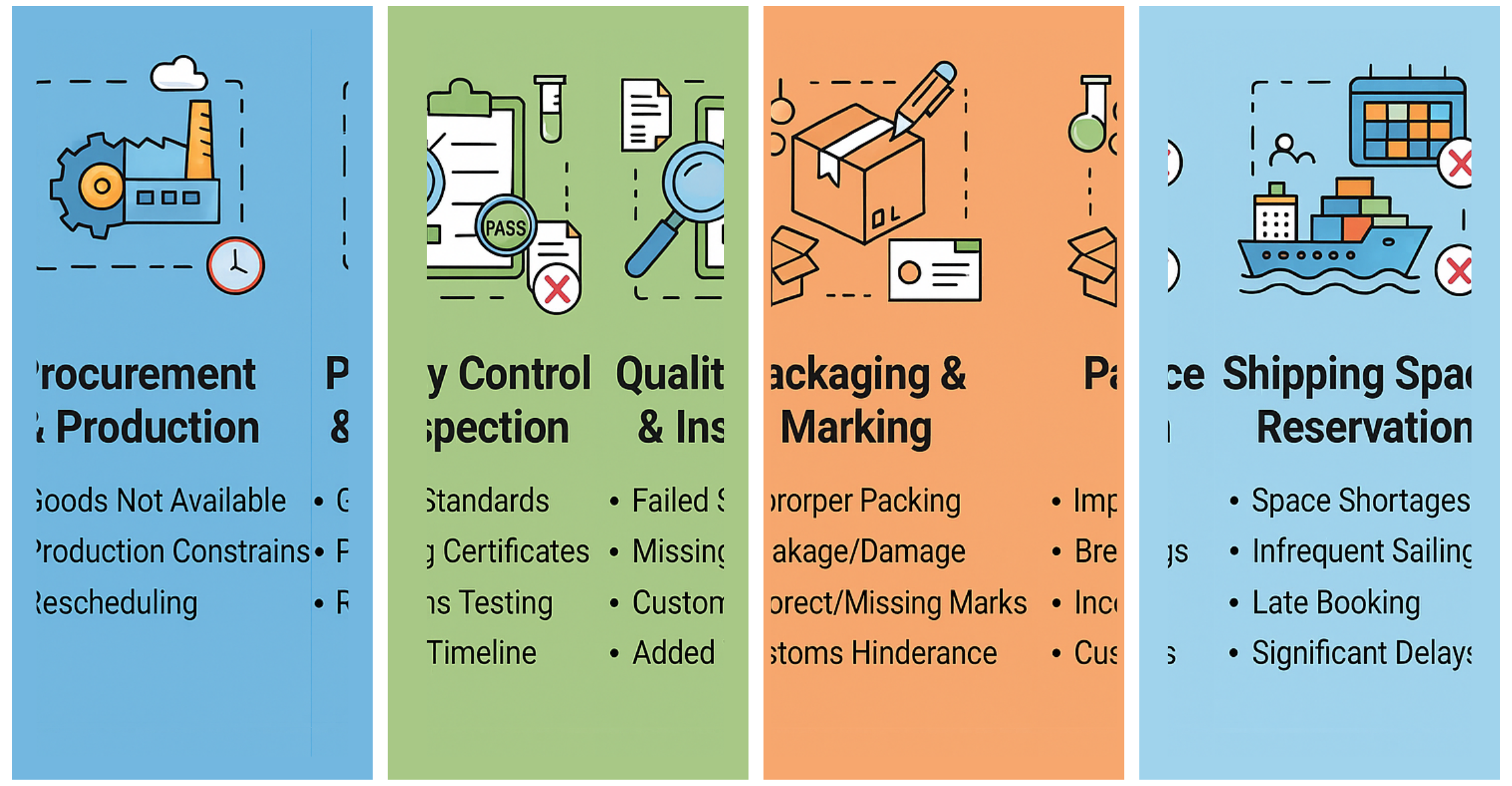
- Procurement and Production: Delays can occur if goods are not readily available or if there are production constraints requiring rescheduling.
- Quality Control and Inspection: Failure to adhere to quality standards or obtain necessary inspection certificates can prevent goods from being shipped. Samples might need to be drawn and tested by customs or inspection agencies, adding to the timeline.
- Packaging and Marking: Improper or non-compliant packing can lead to breakage, moisture damage, pilferage, or excessive weight, causing delays or losses. Incorrect or missing markings can also hinder customs clearance.
- Shipping Space Reservation: Shortages of shipping space or infrequent sailing schedules, particularly for sea transport, can significantly delay shipments if not planned and reserved well in advance.
2. During Transit and At Ports/Customs

-
Customs Clearance:
This is a major bottleneck, as goods cannot legally
leave or
enter a country without customs permission.
- Documentation Errors: Missing or incorrect documents are cited as causing more shipment delays than any other factor. Even minor discrepancies in documents submitted under a Letter of Credit can lead to rejection of payment or significant clearance delays.
- Physical Examination: Customs officers may physically examine goods to verify their consistency with declarations. Discrepancies or suspicions, such as broken or tampered container seals, can lead to re-examination and extended delays.
- Antiquated Procedures: Manual or outdated customs processing and complex rules, as historically experienced in countries like India, can cause substantial delays.
- Duty Payment: Goods are often held until estimated import duties are paid.
- Port Congestion: Overcrowded ports can lead to vessels being detained, impacting turnaround times and overall shipping efficiency.
- Transshipment: When goods are transferred between different modes of transport or carriers, there's a risk of damage and extended journey times if connecting transport is not readily available.
- Legal and Regulatory Non-compliance: Changes in import duties, new tariff barriers, or non-compliance with foreign laws can disrupt market entry. Goods may even be confiscated if smuggling is suspected.
- External Factors: Unforeseen events like wars, civil conflicts, coups, rebellions, or even strikes can block or delay both payment and the physical movement of goods.
3. Post-Shipment Stage (Interlinked with Financial Flow)
- Document Presentation and Negotiation: Shipping documents must be presented to banks within specific timeframes (e.g., 21 days from shipment). Delays in submission can lead to rejection of documents and complications in receiving payment.
- Realisation of Export Proceeds: Exporters are obligated to realize payment for goods within a prescribed period (e.g., nine months from shipment in India).
Test Your Knowledge
Question 1: Name two common issues that can occur during the pre-shipment stage of material flow.
Question 2: What is considered a major bottleneck during transit and at ports/customs?
Question 3: How can documentation errors impact material flow, especially under a Letter of Credit?
Physical Movement of Goods in Export
The physical movement of goods in export, from the factory to the overseas buyer, involves a series of meticulously coordinated steps, encompassing documentation, inspection, warehousing, and customs clearance. This entire process is commonly referred to as material flow.
Here is a step-by-step explanation:
1. Pre-Shipment Stage (at Exporter's Location)
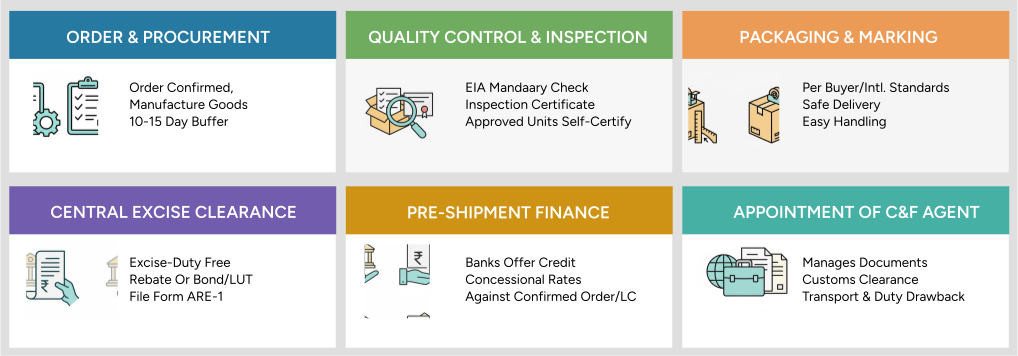
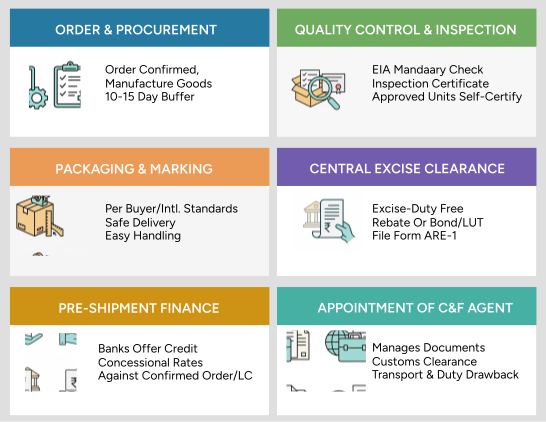
1. Order Confirmation & Procurement: Process starts after order confirmation. Exporter reviews details and procures or manufactures goods per buyer specs, keeping a 10–15-day buffer.
2. Quality Control & Inspection: Mandatory inspection for items under the Export (Quality Control & Inspection) Act, 1963. EIA inspects goods and issues an Inspection Certificate. Approved units may self-certify.
3. Packaging & Marking: Goods are packed and labeled per buyer or international standards to ensure safe delivery and easy handling.
4. Central Excise Clearance: Exports are excise-duty free—either by rebate or bond/LUT. Exporter files Form ARE-1 for clearance.
5. Pre-Shipment Finance: Banks offer packing credit at concessional rates against confirmed orders or LCs.
6. Appointment of C&F Agent: A C&F (freight forwarder) manages documentation, customs clearance, transport, and duty drawback.
2. Movement to Port / Pre-Loading Stage

1. Shipping Space Reservation:
The exporter must make necessary arrangements for shipping space once the export contract is confirmed, especially for sea transport due to potential shortages and limited frequency. A Shipping Order indicates a commitment from the shipping company to provide space, unlike a "Shipping Advice" which is merely an intimation of potential acceptance.
2. Local Transportation:
Once cleared from the factory, goods are transported to the docks or port premises. In the case of containerized cargo, empty containers may be brought to the exporter's factory for stuffing after obtaining customs permission.
3. Container Arrangement and Stuffing:
Goods are stuffed into containers, which are then sealed by Central Excise officers. This process can occur at the factory, an Inland Container Depot (ICD), or a Container Freight Station (CFS). ICDs and CFSs provide port-like facilities inland, overcoming locational disadvantages for exporters not near seaports.
4. Documents for C&F Agent:
The exporter provides the C&F agent with a complete set of shipping documents, including ARE-1, Commercial Invoice, GR Form/SDF, Letter of Credit/Export Contract, Packing List, Certificate of Origin, Inspection Certificate, and Marine Insurance Policy.
3. Customs Clearance at Port
1. Document Submission: C&F agent files the required Shipping Bill (Free, Dutiable, Drawback, or Ex-Bond) and related forms (SDF via EDI system) for customs clearance.
2. EDI System: The Indian Customs EDI System (ICES) enables paperless filing, real-time tracking, and faster clearance using a PAN-based BIN.
3. Document Verification: Customs checks documents for compliance with inspection, licensing, and exchange control norms.
4. Carting Order: C&F agent secures a Carting Order to move cargo inside the port.
5. Physical Examination: Customs inspects goods; if excise-sealed, only the seal is verified.
6. Let Export Order: Issued after satisfactory examination, authorizing shipment.
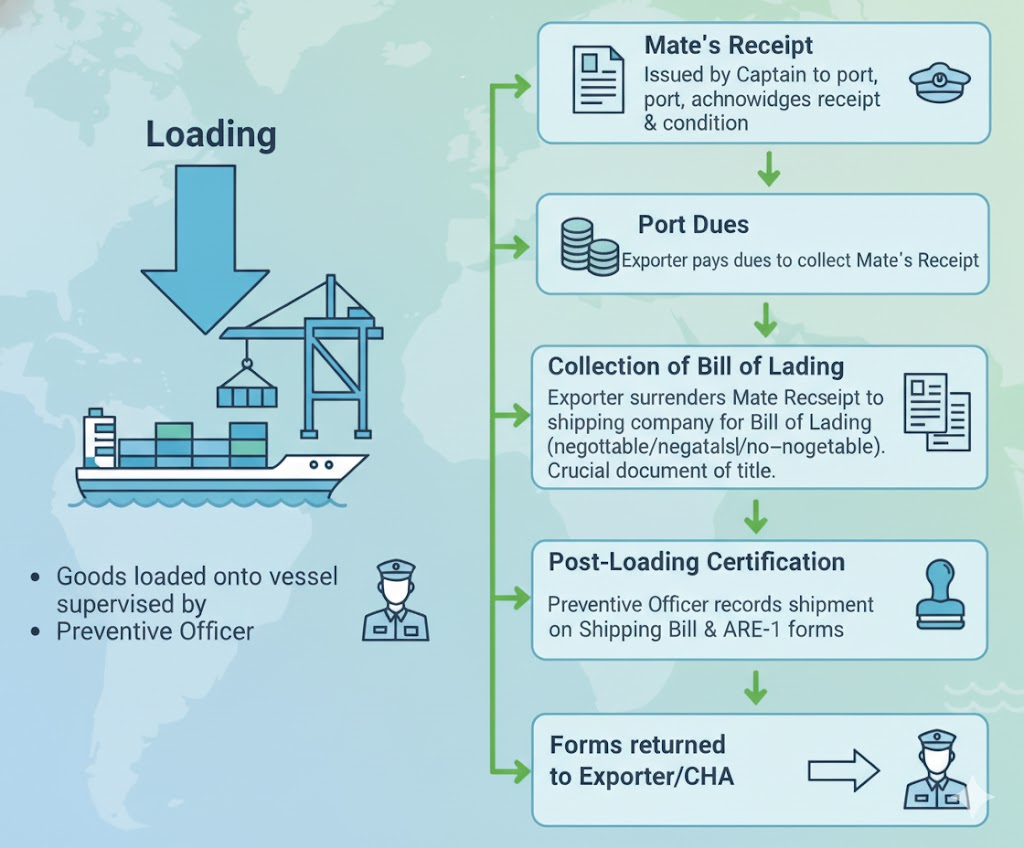
7. Let Ship Order: Given by the Preventive Officer, allowing cargo loading onto the vessel.
4. Loading and Post-Loading at Port
5. Transit to Overseas Buyer
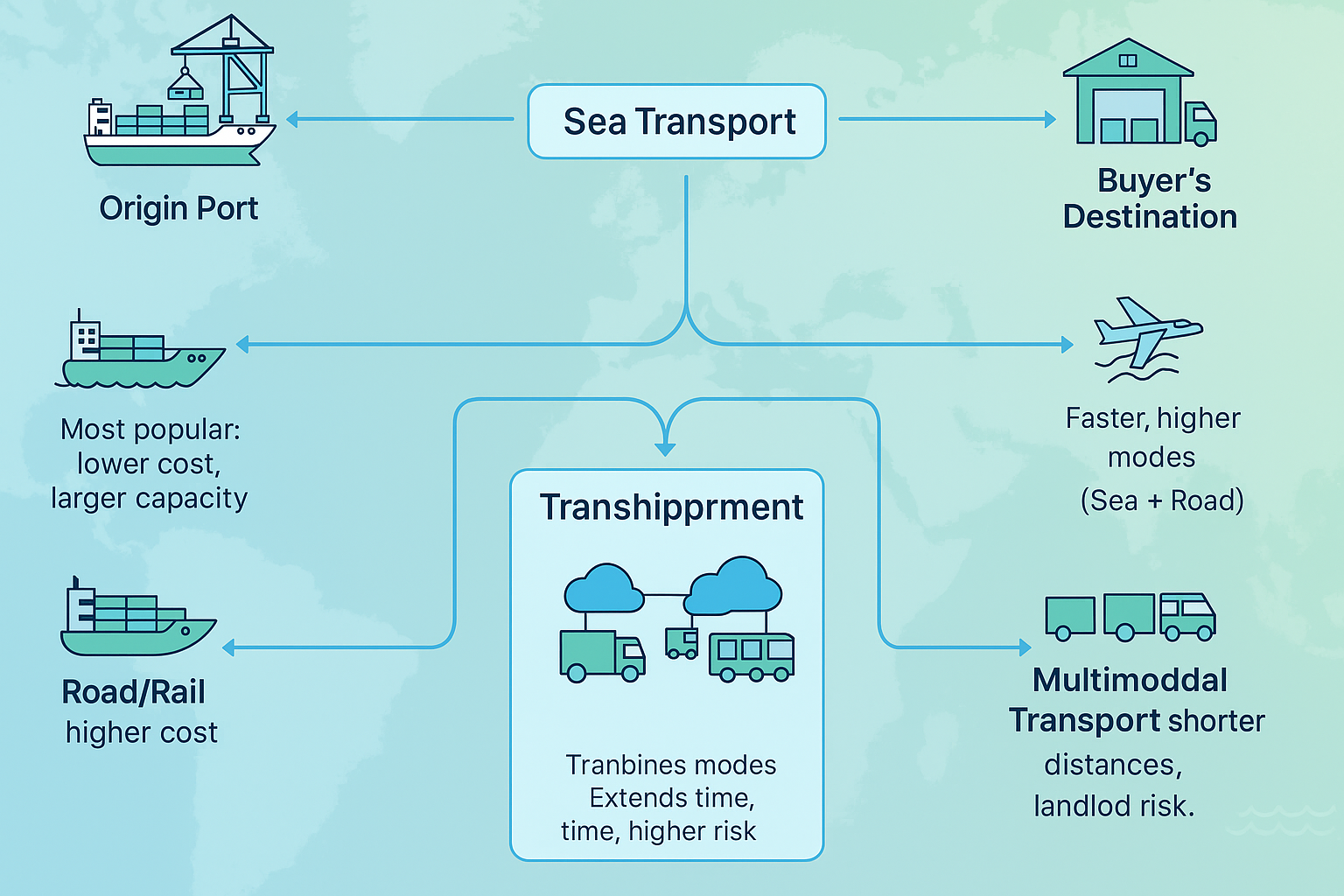
- The goods physically move from the port of origin to the overseas buyer's destination. This can involve sea transport (most popular for cargo due to lower freight and larger size capability), air transport, multimodal transport (combining various modes like sea, road, rail, air), or road transport.
- Transshipment, where goods are transferred between different modes or carriers, can occur en route. While it allows access to markets without direct links, it can extend journey times and increase risk of damage.
6. Post-Shipment Stage (Interacting with Financial Flow)

Documents Returned to Exporter:
- The forwarding agent returns key documents to the exporter, including attested invoice, Export Promotion copy of Shipping Bill, full sets of clean Bill of Lading, original Letter of Credit/export contract, and ARE-1 forms.
Presentation of Documents for Negotiation:
- After shipment, the exporter must present all relevant documents, including the Bill of Exchange, Bill of Lading/Airway Bill, Commercial Invoice, Packing List, Certificate of Origin, and Foreign Exchange Forms (GR/SDF/SOFTEX/PP Forms), to their bank for negotiation within 21 days from the date of shipment.
- This process is crucial for obtaining payment.
Realization of Export Proceeds:
- The exporter is obligated to realize the full value of goods exported within a prescribed period, typically nine months from the date of shipment. The Bank Realisation Certificate (BRC) or e-BRC (Electronic Bank Realisation Certificate) is a vital digital certificate confirming payment and is necessary for availing export benefits and incentives.
Claiming Export Incentives:
- Exporters can claim various incentives, such as Duty Drawback (refund of customs and excise duties on inputs) and CENVAT Credit (credit for excise duty paid on inputs), by submitting the necessary documentation (e.g., ARE-1, Shipping Bill) to the relevant authorities after export.
Supply Chain Visibility:
- Supply chain visibility, enabled by systems like ICES, allows for tracking products and documents throughout the EXIM process.
- This transparency helps in compliance, proactive risk management, and cost efficiencies by expediting processes and reducing delays caused by manual errors or lost documents.
- Features like online status checks for Shipping Bills and automated processes minimize human intervention, leading to faster operations and better stakeholder relationships.
Test Your Knowledge
Question 1: What is ICES and when was it implemented in India?
Question 2: What are Incoterms and which organization developed them?
Question 3: Name three benefits of the Aligned Documentation System (ADS).
Material Flow Documents
1. MATERIAL FLOW (Primary Focus: Physical Movement & Tracking)
| Document Name | Who Uses It | Importance Level | Mandatory / Optional | Trade Face |
|---|---|---|---|---|
| Packing List | Exporter | Critical | Mandatory | Pre-Shipment |
| Shipper's Export Declaration (SED) | Exporter | High | Mandatory | Customs Clearance |
| Certificate of Manufacture | Exporter | Medium | Optional | Pre-Shipment |
| Inspection Certificate | Exporter | High | Optional**** | Pre-Shipment |
| Phytosanitary Certificate | Exporter | Critical* | Mandatory* | Pre-Shipment |
| Entry Manifest (U.S.) / Bill of Entry (India) | Importer | Critical | Mandatory | Customs Clearance |
| Entry Summary (U.S.Customs Form 7501) | Importer | Critical | Mandatory | Customs Clearance |
| EWay - Bill (India Specific) | Consignor/consignee/transporter | Critical** | Mandatory** | Inland Transportation |
| Technical Specifications | Both Importer and Exporter | High | Optional | General / Supporting |
| Bill of Lading (B/L) / Air Waybill (AWB) | Both Importer and Exporter | Critical | Mandatory | Shipment & Transportation |
| Air Waybill (AWB) | Both parties | Critical | Mandatory | Shipment & Transportation |
| Ocean Bill of Lading | Both parties | Critical | Mandatory | Shipment & Transportation |
| Straight Bill of Lading | Both parties | High | Optional | Shipment & Transportation |
| Order Bill of Lading | Both parties | Critical | Optional | Shipment & Transportation |
| Clean on Board Bill of Lading | Both parties | High | Optional | Shipment & Transportation |
| Foul Bill of Lading | Both parties | High | Optional | Shipment & Transportation |
| Combined Transport Bill of Lading | Both parties | High | Optional | Shipment & Transportation |
| Contract of Carriage | Carrier/Shipper | High | Mandatory | Shipment & Transportation |
| Express Bill of Lading | Carrier/Shipper | High | Optional | Shipment & Transportation |
| House Bill of Lading | Freight Forwarder | High | Optional | Shipment & Transportation |
| Sea Waybill | Carrier/Shipper | High | Optional | Shipment & Transportation |
| Surrender Bill of Lading | Carrier / Consignee | High | Optional | Shipment & Transportation |
Test Your Knowledge
Question 1: Which document is mandatory for both exporters and importers and is used for customs clearance in India?
Question 2: What is the "Importance Level" for a "Packing List"?
Question 3: Who typically uses the "Phytosanitary Certificate" and what is its mandatory status?
How Incoterms Affect Material Responsibility (Risk)
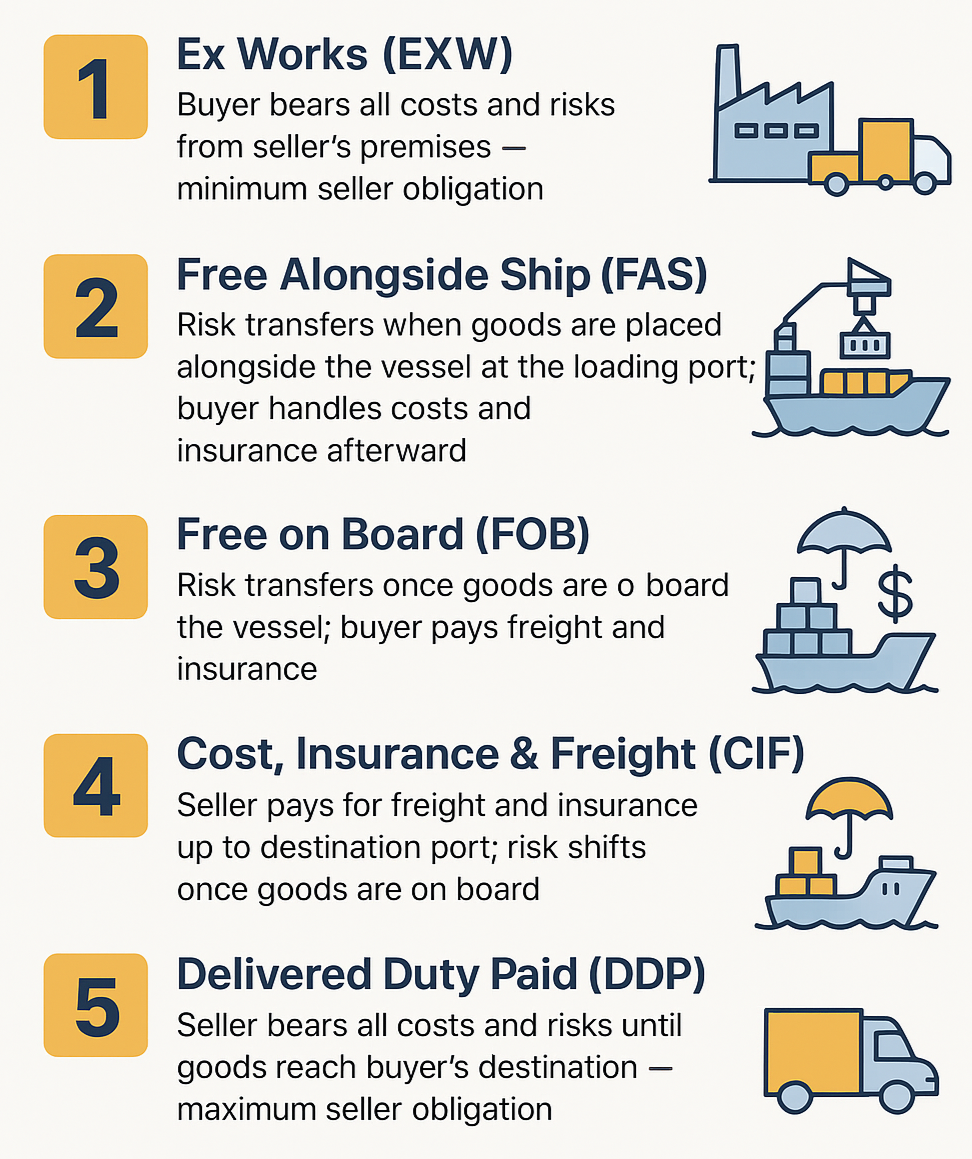
Incoterms are international rules by the ICC that standardize trade terms in global contracts, preventing misunderstandings. They define the exact point where risk and cost transfer from exporter to importer, determining who is responsible for the goods during transit.
1. Risk Transfer
Incoterms define when the seller’s responsibility for cost and risk transfers to the buyer during shipment.
2.
1. Clarity & Dispute Avoidance: Defines clear cost and risk responsibilities, reducing misunderstandings and legal disputes.
2. Cost Allocation: Determines who pays for packing, freight, insurance, duties, and taxes—directly affecting total landed cost.
3. Pricing & Competitiveness: Helps exporters price accurately and stay competitive in global markets.
4. Insurance Responsibility: Specifies who arranges and pays for transit insurance (seller in CIF, buyer in FOB/C&F).
5. Financing Impact: Incoterms like CIF require higher exporter funding than FOB due to added freight and insurance costs.
6. Compliance & Documentation: Affects customs paperwork, bank negotiations, and payment timing—errors can delay payment.
7. Mode of Transport: Different terms apply to sea (FAS, FOB, CIF) or all transport modes (EXW, CIP, DDP), ensuring proper logistics alignment.
Test Your Knowledge
Question 1: What is the core function of Incoterms regarding risk transfer?
Question 2: Under which Incoterm does the seller have the minimum obligation?
Question 3: How do Incoterms influence pricing strategy for exporters?